
Short answer
There is no established KPV dose for people, because KPV has never been studied in a human. Mouse colitis studies used 100 µM in drinking water or 16 µg/kg a day inside nanoparticles; a rabbit eye study used 1 to 10 mg/mL drops. None of these is a human dose. KPV is not FDA-approved.
- What it is
- A three-amino-acid peptide (Lys-Pro-Val), the C-terminal end of alpha-melanocyte-stimulating hormone, studied for anti-inflammatory effects in cells and animals.
- FDA status
- Not FDA approved
Not approved, no label and no approved dose. Not on the 503A bulks list. An October 2026 HHS enforcement policy tolerates topical and oral KPV acetate under ten conditions and sets no dose; injected KPV is not covered.
- Evidence level
Animal studies only
No controlled human trials. Everything below is animal or lab data.
No one knows what dose of KPV, if any, does anything in a person, because no one has measured it. FDA’s May 2026 review of KPV found no clinical studies, no human pharmacokinetic data (how a drug is absorbed and cleared) and no human exposure of any kind. The only numbers that exist come from animals and cells, and they are reported below for what they are. Nothing here is a recommendation. KPV is not FDA-approved and has no label, so no one can give you a dose with human evidence behind it.
What the animal and cell studies used
| Study | Species or model | Dose | Route | Schedule |
|---|---|---|---|---|
| Dalmasso et al. 2008 (colitis) | Mice, 3% DSS or TNBS colitis | 100 µM KPV | In drinking water | Throughout the 8-day DSS course; TNBS mice assessed at 48 hours |
| Laroui et al. 2010 (colitis) | Mice, DSS colitis | KPV in nanoparticles at a concentration 12,000-fold lower than free KPV, with similar effect | By mouth, in an alginate-chitosan gel | Not stated in the abstract |
| Xiao et al. 2017 (colitis) | Mice, 3.5% DSS colitis | 16 µg/kg a day, inside hyaluronic acid-coated nanoparticles | By mouth (gavage, twice daily), in a gel | 5 days |
| Cheng et al. 2026 (colitis) | Mice with colitis | An engineered KPV conjugate, effective at a 20-fold lower dose than free KPV | By mouth | Not stated in the abstract |
| Bonfiglio et al. 2006 (cornea) | Rabbits, scraped cornea | 1, 5 or 10 mg/mL, 30 µL drops | Eye drops | Two drops four times a day for 4 days |
| An et al. 2026 (fat cells) | Mouse fat cells in a dish | 100 µg/mL | Added to culture | Not applicable |
| FDA review 2026 (proposed product) | Not tested | 0.1% cream or gel | Skin | Not specified |
Some of these numbers are easier to read in plainer units. KPV free base weighs 342.43 g per mole, so 100 µM is about 34 mg per liter of drinking water, or 0.034 mg/mL. The study did not report how much each mouse drank, so the dose per kilogram is not known. A 0.1% cream is 1 mg of KPV per gram. The rabbit eye drops contained 30 to 300 µg per drop. These figures are not comparable to each other, let alone to anything a person might use.
Why these numbers do not become a human dose
There is nothing to scale from. FDA’s 2005 guidance on first-in-human dosing starts from a dose that formal toxicology studies have shown to cause no harm in animals, then builds in a large safety margin for a supervised trial. FDA’s 2026 review found no acute, repeat-dose, genotoxicity, reproductive or carcinogenicity studies of KPV. The starting point the method needs does not exist, so any human number built from these mouse studies would be invented, and we do not publish one.
The formulation was the point. The best-defined mouse doses were inside nanoparticles or conjugates engineered to release KPV in the colon. The 2010 study’s headline finding was that packaging cut the needed concentration 12,000-fold. A vial of plain KPV powder, injected under the skin or swallowed, is a different product, and the mouse data say nothing about how much of it reaches any tissue.
Route changes everything. The colitis studies dosed by mouth to treat the colon from the inside. The rabbit study put drops directly on the eye. FDA’s review notes that KPV passes poorly through intact human skin. An injection under the skin, a route promoted online, was not used in any of the studies above. FDA found websites promoting injectable, oral, topical and nasal spray KPV; no human study supports a dose for any of them.
Short, artificial disease models. The colitis was chemically induced over days. Human inflammatory bowel disease lasts years. No study measured what months of KPV exposure does to an animal, let alone a person.
How much, how often, and what about a missed dose?
There is no tested answer to any of these, and it is better to say so plainly than to borrow a schedule from a forum.
- How much per day: not established. The October 2026 HHS policy names forms and routes and sets no dose.
- How often and for how long: not established. The longest colitis course in the table above lasted about a week, in mice.
- Time of day, with or without food: never studied in people.
- Missed doses: a missed-dose rule comes from a label, and KPV has no label.
- What happens at each step up: unknown. There are no steps, because no dose-finding study has been done.
What the HHS policy says about dose
Nothing. As of November 2, 2026, HHS says it does not intend to take enforcement action against a state-licensed pharmacy, federal facility or licensed physician compounding KPV acetate in topical or oral forms, if ten conditions are met, until a final rule addresses KPV. Those conditions cover the ingredient’s identity and testing, a patient-specific prescription, a single active ingredient and adverse event reporting. An oral product also requires documentation of adequate oral bioavailability in humans, which is hard to square with FDA’s finding of no human absorption data. Injected KPV is not covered.
The policy is not an approval. KPV is not on the 503A bulks list, no rule has been proposed, and FDA has reviewed no compounded product for safety, effectiveness or quality. The notice says the policy is not binding, comments are open until November 13, 2026, HHS may revisit it if a safety signal or quality problem appears, it covers 503A compounding only, and states can be stricter. A prescriber who wrote for compounded KPV would be choosing an amount with no human data behind it, and a patient deserves to hear that directly.
Vial and syringe arithmetic
Online sellers offer KPV as a freeze-dried powder that the user mixes with bacteriostatic water, and FDA found injection promoted on websites. This section is here because math errors with vials can be large; it does not mean injecting KPV is supported, safe or covered by any policy. Our reconstitution guide covers the mechanics that apply to any peptide. The marks on an insulin syringe measure volume, so the water volume decides how much peptide each unit holds.
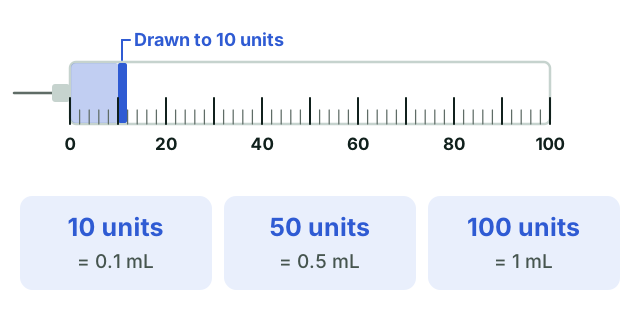
A worked example with a 5 mg vial, which is an illustration and not a fact about any product:
- 5 mg = 5,000 mcg. The vial holds that amount however much water is added.
- Add 2 mL: 5,000 mcg divided by 2 mL = 2,500 mcg per mL.
- A U-100 insulin syringe holds 100 units per mL, so 1 unit = 0.01 mL.
- 2,500 mcg per mL divided by 100 = 25 mcg per unit.
| Water added to a 5 mg vial | Concentration | Peptide per unit (U-100) |
|---|---|---|
| 1 mL | 5 mg/mL | 50 mcg |
| 2 mL | 2.5 mg/mL | 25 mcg |
| 2.5 mL | 2 mg/mL | 20 mcg |
The table describes arithmetic, and we leave out dose columns on purpose because no KPV dose exists. The reconstitution calculator below does the same math for any vial and any volume, and the mg/mL to units converter works the other way round.
Reconstitution calculator
U-100 syringeThe errors that cost people most with vials:
- Mixing up mg and mcg. 1 mg is 1,000 mcg. A thousandfold error is one misplaced unit away.
- Reading units as micrograms. A unit is a hundredth of a milliliter. What it contains depends on the concentration.
- Copying someone else’s numbers. A unit count from a vial mixed with 1 mL is wrong for a vial mixed with 2 mL.
- Trusting the label on the vial. FDA found that “KPV” is not a standardized name and that different salts and derivatives are sold under it. A research-grade vial has no FDA-verified identity, potency or sterility, so even correct arithmetic rests on an unverified number.
The legal line for research vials
Products sold “for research use only” are not legal to use on people. The label comes from 21 CFR 312.160, which permits shipment only for laboratory animal or test-tube work, marked “Not for use in humans.” HHS says its October 2026 policy is meant to discourage this market, and the policy gives such products no cover. The KPV benefits page has the evidence behind each claim, and the FDA status tracker follows the rulemaking.
Compare
Recent news on this
Peptide news, sorted. Plus the printable dose chart.
Sorted, every Tuesday: the week's peptide and GLP-1 news in five minutes: FDA moves, new studies explained, and price changes. Subscribe and the one-page dose and injection-site chart arrives first.
Questions people ask
What is the standard KPV dose?
How much KPV per day?
Can I convert the mouse dose to my body weight?
How do syringe units work with a KPV vial?
Is oral KPV the same as injected KPV?
When is the best time to take KPV?
Sources
Primary sources first: FDA labels and documents, peer-reviewed trials, registries.
- 1FDA. Briefing document: evaluation of KPV-related bulk drug substances, Pharmacy Compounding Advisory Committee, July 23-24, 2026 (memo dated May 12, 2026)fda.gov
- 2HHS. Enforcement Discretion Policy Regarding 503A Compounding Using Certain Peptide Bulk Drug Substances, with Appendices A and B, October 2026hhs.gov
- 3Federal Register. Notice of availability, FR Doc. 2026-22192, Docket HHS-OASH-2026-0496, RIN 0910-ZD94, published October 30, 2026public-inspection.federalregister.gov
- 4AJMC. 5 things to know about HHS's interim peptide compounding policy, 2026ajmc.com
- 5Dalmasso G et al. PepT1-mediated tripeptide KPV uptake reduces intestinal inflammation. Gastroenterology 2008 (full text, PMC)pmc.ncbi.nlm.nih.gov
- 6Xiao B et al. Orally targeted delivery of tripeptide KPV via hyaluronic acid-functionalized nanoparticles efficiently alleviates ulcerative colitis. Mol Ther 2017 (full text, PMC)pmc.ncbi.nlm.nih.gov
- 7Laroui H et al. Drug-loaded nanoparticles targeted to the colon with polysaccharide hydrogel reduce colitis in a mouse model. Gastroenterology 2010pubmed.ncbi.nlm.nih.gov
- 8Cheng J et al. Inflammation-triggered self-immolative conjugates enable oral peptide delivery by overcoming gastrointestinal barriers. Sci Adv 2026pubmed.ncbi.nlm.nih.gov
- 9Bonfiglio V et al. Effects of the COOH-terminal tripeptide alpha-MSH(11-13) on corneal epithelial wound healing. Exp Eye Res 2006pubmed.ncbi.nlm.nih.gov
- 10An SH et al. KPV attenuates adipogenesis and lipid metabolism through modulation of ROS-mediated AKT/mTORC1/PPARgamma signaling. Tissue Cell 2026pubmed.ncbi.nlm.nih.gov
- 11FDA. Guidance for industry: estimating the maximum safe starting dose in initial clinical trials for therapeutics in adult healthy volunteers, July 2005fda.gov
- 1221 CFR 312.160, drugs for investigational use in laboratory research animals or in vitro testslaw.cornell.edu
More on KPV
- OverviewKPVKPV is an anti-inflammatory tripeptide studied in cells and mice. No human study exists and it is not FDA-approved. What changed with HHS in October 2026.
- BenefitsKPV is promoted for gut, skin, wounds and infections. Every claim rests on cell or animal work, and FDA found no human study. See each claim checked.Read
PeptideSorted Editorial Team
Editorial review
The PeptideSorted editors check every guide against its cited sources before publication: each number against its FDA label, trial or registry, the FDA status against current FDA and HHS documents, and the wording against our describe-never-prescribe rule. Licensed clinicians who join the review panel are listed by name on the editorial team page.
This page was checked against its cited sources by the PeptideSorted editorial team. Licensed clinicians on our review panel are listed on the editorial team page. Every health page cites primary sources and shows its review date. Read the editorial policy and how medical review works, or report an error via corrections. Educational only; not medical advice.