Short answer
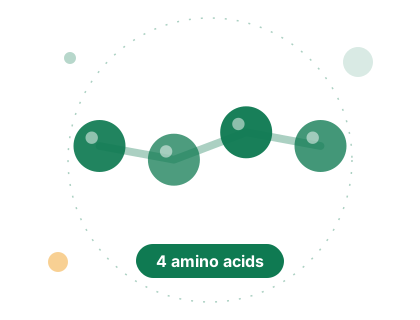
SS-31 is elamipretide, a four-amino-acid mitochondrial peptide that FDA approved as Forzinity on September 19, 2025 under accelerated approval. It is approved only to improve muscle strength in people with Barth syndrome weighing at least 30 kg. The approval rests on a small open-label extension, and it is not approved for aging or energy.
- What it is
- A mitochondria-targeted tetrapeptide (D-Arg-Dmt-Lys-Phe-NH2) that binds cardiolipin; the active ingredient in Forzinity.
- FDA status
- FDA approved
Forzinity (elamipretide) injection, NDA 215244, accelerated approval September 19, 2025, to improve muscle strength in adult and pediatric patients with Barth syndrome weighing at least 30 kg. Continued approval depends on a confirmatory trial.
- Evidence level
FDA label
Dosing comes from the FDA-approved prescribing information.
SS-31 is the old lab name for elamipretide, and it became a real drug. FDA approved it as Forzinity on September 19, 2025, the first treatment for Barth syndrome. That approval is narrow, accelerated and based on very few patients, and it covers only the manufacturer’s product. “SS-31” vials sold for research are a different thing legally and, as far as anyone can verify, chemically. It is one of the rare entries in our peptide index with an FDA label, so here is what that label says.
| Label item | What the Forzinity label says |
|---|---|
| Indication | To improve muscle strength in adult and pediatric patients with Barth syndrome weighing at least 30 kg |
| Approval type | Accelerated approval, based on knee extensor muscle strength, an intermediate endpoint; continued approval may depend on a confirmatory trial |
| Dose | 40 mg subcutaneously once daily for patients 30 kg and over |
| Kidney impairment | 20 mg once daily in adults with eGFR under 30 mL/min not on dialysis; no dose recommendation for adults on dialysis |
| Form | 280 mg/3.5 mL (80 mg/mL) solution in single-patient-use vials, preserved with benzyl alcohol |
| Where injected | Abdomen (at least 2 inches from the navel) or outer thigh, rotating sites daily |
| After opening | Discard vials 8 days after first opening |
| Contraindication | Serious hypersensitivity to elamipretide or any ingredient |
| Warnings | Benzyl alcohol toxicity in newborns; hypersensitivity reactions |
| Most common adverse reaction | Injection site reactions |
The label is describing a prescription drug for a rare disease; the prescriber sets the dose. For how subcutaneous injections are given generally, see the injection sites guide.
What is SS-31?
Elamipretide is four amino acids, written D-Arg-Dmt-Lys-Phe-NH2: a mirror-image arginine, a modified tyrosine (2,6-dimethyltyrosine), lysine and phenylalanine amide. The label calls it a “mitochondrial cardiolipin binder.” The company now reporting on Forzinity is Mighty Therapeutics; FDA’s database lists the application under Stealth BioTherapeutics.
What does SS-31 do?
SS-31 binds cardiolipin, a fat molecule found almost only in the inner membrane of mitochondria, where it holds together the machinery that makes cellular energy. The label says elamipretide “localizes to the inner mitochondrial membrane and improves mitochondrial morphology and function.”
That mechanism fits Barth syndrome closely. Barth syndrome is a rare, X-linked inherited disease, almost always in males, caused by defects in the TAZ gene, which leaves cardiolipin abnormal. It causes heart muscle disease, skeletal muscle weakness, low neutrophil counts and fatigue.
The same mechanism is why SS-31 attracts people interested in aging and energy. The idea is plausible. Outside Barth syndrome it remains unproven.
Who is Forzinity for?
Forzinity is for one group: people with Barth syndrome who weigh at least 30 kg. The company reports 60 patient enrollment forms and 48 prescribers from its December 2025 soft launch through September 2026, which gives a sense of scale. The company plans a one-month pharmacokinetic study this year to support a possible 2027 application for children weighing at least 7 kg, and it treats smaller children through expanded access. None of that has changed the label.
What the trials showed
Barth syndrome (TAZPOWER)
The label describes one randomized trial and its extension:
- Randomized phase: 12 males aged 12 and over, each given 12 weeks of elamipretide 40 mg daily and 12 weeks of placebo in random order. Elamipretide “was not superior to placebo” on either primary endpoint: distance walked in six minutes, or a Barth fatigue score. Knee strength did not improve in this phase either.
- Open-label extension: 10 patients continued on elamipretide with no placebo comparison, 8 of them through week 168. Knee extensor strength rose from a median baseline of 124 newtons; the median change was 68 newtons at week 24 (9 patients) and 63 newtons at week 168 (8 patients).
FDA judged the strength gain “reasonably likely” to predict real benefit and approved on that basis, with a confirmatory trial required. The confirmatory study must be randomized, double-blind and placebo-controlled, in patients aged 5 and over. FDA’s approval letter refers to an earlier FDA action on the application dated May 15, 2025, which the company answered in August 2025.
The first participant has now been dosed in that study, called 4TAZPower, according to the company’s October 2026 update, with sites started in Canada, Australia, Ireland and the United Kingdom. The label says continued approval may depend on verifying clinical benefit in a confirmatory trial. Until then, the strength gains come from a study with no placebo group.
Other uses tested
Elamipretide has been tested beyond Barth syndrome, and so far it has not cleared the bar in any other disease.
| Condition | Trial | Who | What happened |
|---|---|---|---|
| Primary mitochondrial myopathy | MMPOWER-3, phase 3 | 218 adults, 40 mg a day or placebo for 24 weeks | Did not meet its primary endpoints of six-minute walk distance and fatigue |
| Dry age-related macular degeneration | ReCLAIM-2, phase 2 | 176 people, 117 on 40 mg a day, 59 on placebo | Did not meet its primary endpoints of low-light vision and lesion size; authors reported a favorable change on a retina measure; 29% vs 14% left early |
| Dry age-related macular degeneration | ReNEW, phase 3 | Fully enrolled, per the company | Results expected in the second half of 2027 |
| Older adults | Planned placebo-controlled trial | Company says it will run through 2029 | Not yet reported |
No other indication is approved.
Does SS-31 help with aging or energy?
No study has shown that it does. Forzinity is approved only for Barth syndrome, and the largest trial in adults with mitochondrial disease missed its goals. A planned trial in older adults will not finish before 2029, according to the company. Nothing published today tells a healthy person what to expect from SS-31, how fast, or at what dose. Research-market vials add a second unknown, which is what is actually in them.
SS-31 side effects and warnings
From the label’s placebo-controlled crossover data (12 patients):
| Reaction | Elamipretide | Placebo |
|---|---|---|
| Any injection site reaction | 12 (100%) | 8 (67%) |
| Injection site redness | 12 (100%) | 3 (25%) |
| Injection site pain | 9 (75%) | 5 (42%) |
| Injection site hardening | 8 (67%) | 2 (17%) |
| Injection site itching | 8 (67%) | 2 (17%) |
| Injection site bruising | 3 (25%) | 0 |
| Injection site hives | 3 (25%) | 0 |
- Hypersensitivity. The label reports allergic reactions, “including serious allergic reactions requiring emergency medical intervention,” with rash, skin lesions, eczema-like dermatitis and cough. They “may occur within minutes to months” after starting, and the company’s safety information says to stop permanently after a serious reaction.
- Eosinophils. Counts of eosinophils, a white blood cell involved in allergy, rose often with 30 days or more of treatment, peaked around 90 days and returned to baseline within 6 to 12 months, without symptoms.
- Newborns. Each mL contains 20 mg of benzyl alcohol, the preservative linked to fatal “gasping syndrome” in premature babies. Forzinity is not approved for newborns or for intravenous use.
- Kidneys. Elamipretide and its breakdown products leave through the urine. Exposure more than doubled (up 125%) in severe kidney impairment, which is why the label lowers the dose.
- Unknowns. The label notes that no carcinogenicity studies have been done, and that no patients 65 or older were studied.
How is Forzinity given and stored?
Forzinity arrives as a ready-made liquid, so there is no powder to mix. The label’s 40 mg dose is 0.5 mL of the 80 mg/mL solution, injected under the skin once a day at about the same time. A 3.5 mL vial therefore holds seven daily doses, which fits inside the rule to discard a vial 8 days after first opening. Unopened vials go in the refrigerator at 36 to 46 degrees F and must not be frozen. Once opened, a vial can stay refrigerated or sit at room temperature, 68 to 77 degrees F. If a dose is missed, the label says to skip it and take the next one at the usual time, never a double dose.
The Instructions for Use recommend that an adult prepare and give the injections, with a new syringe and needle every time, and only the syringes the prescriber supplies or that come with the medicine, because “using the wrong syringe can lead to a mistake in your dose.” The label’s counseling section says injection site reactions such as redness, itching or hives can be treated with antihistamines or steroid creams.
Pregnancy, breastfeeding and other medicines
Barth syndrome is X-linked and is not likely to affect females, so the label has no human data on pregnancy or breastfeeding. Studies in pregnant rats and rabbits found no harm to development at exposures up to about 10 times those at the human dose. The label adds that a pregnant or nursing woman breaks benzyl alcohol down quickly, so exposure of a fetus or breastfed baby is unlikely.
Few interactions have been found so far. In lab tests elamipretide did not block or speed up the main CYP liver enzymes that clear many drugs, though it did inhibit MATE1, a transporter that helps move some drugs out of the body. In small human studies it did not change how aspirin or clopidogrel worked. Lab tests found no liver metabolism, so the label does not expect liver disease to alter how the body handles it.
How much does Forzinity cost?
Forzinity costs roughly $60,000 for a 28-day supply at cash prices. Drugs.com showed about $59,636 for 14 mL, which is four 3.5 mL vials, as of November 2, 2026. At the label’s 0.5 mL (40 mg) a day, 14 mL lasts 28 days. What a family pays depends on coverage. The company reports reimbursement across more than 90% of lives covered by major national health plans, and it runs a patient support program for access and copay help. Those are company figures.
Research-sold SS-31 is not Forzinity
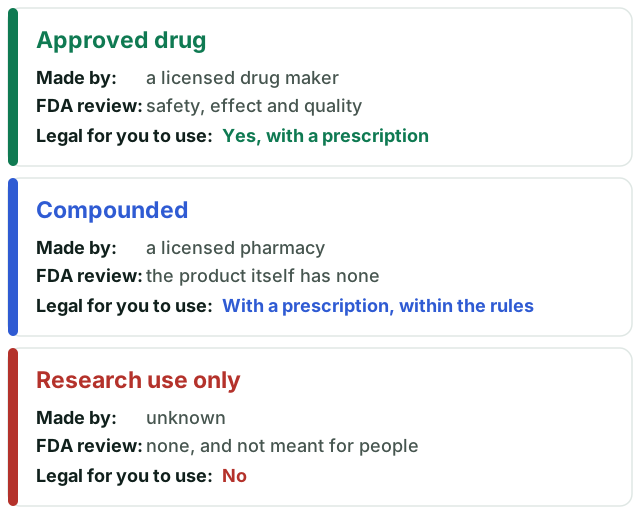
Forzinity is a sterile solution in sealed vials made by its manufacturer under FDA manufacturing rules, released against specifications FDA approved, and dispensed on prescription. “SS-31” or “elamipretide” sold online as a freeze-dried research powder has none of that: no verified identity, strength, purity or sterility, and no label. A seller’s certificate of analysis does not bridge the gap; the COA guide explains why.
It is also not legal to use on people. Under 21 CFR 312.160, a “research use only” product may be shipped only for laboratory animal or test-tube work. Among the five warning letters FDA sent to online peptide sellers on August 24, 2026, products named included SS-31/elamipretide, and FDA found that dosing guidance and reconstitution calculators on the sellers’ sites showed the products were intended for human use. An approved drug existing does not make a copy of it legal; it makes a research copy an unapproved version of an approved drug. SS-31 is also not one of the six peptides in HHS’s October 2026 enforcement policy.
Who should not use it, and what to watch for
- Anyone outside the label. Forzinity is approved only for Barth syndrome in patients weighing at least 30 kg. Its effect in other conditions is unproven, and one phase 3 trial in mitochondrial myopathy failed.
- Serious allergy to any ingredient. That is the label’s one contraindication.
- Newborns. Benzyl alcohol makes it unsuitable.
- Signs to report. Rash, swelling, hives, cough or breathing trouble after a dose, and injection site reactions that are persistent or severe.
Questions to ask a prescriber
- Does the diagnosis of Barth syndrome fit, and does my or my child’s weight meet the label?
- How is kidney function, and does it change the dose?
- What would count as improvement, given that the approval rests on knee strength?
- Is the 4TAZPower trial or a registry an option?
The FDA status tracker lists elamipretide alongside every other peptide, and are peptides safe compares approved, compounded and research-market products.
Compare
- LearnFDA status trackerWhich peptides are FDA-approved, which HHS tolerates under conditions, and which are not legal to use.
- LearnHow to read a COAWhat each line on a peptide COA means: HPLC purity, mass spec identity, net content, endotoxin and sterility, plus red flags and what a COA cannot prove.
- PeptidesNot FDA approvedMOTS-cMOTS-c improved metabolism and running in mice, but no published human trial exists and it is not FDA-approved.
Peptide news, sorted. Plus the printable dose chart.
Sorted, every Tuesday: the week's peptide and GLP-1 news in five minutes: FDA moves, new studies explained, and price changes. Subscribe and the one-page dose and injection-site chart arrives first.
Questions people ask
Is SS-31 FDA-approved?
What does SS-31 do?
What is the Forzinity dose?
What are the side effects of elamipretide?
Does SS-31 help with aging or energy?
Can a doctor prescribe Forzinity off-label?
Sources
Primary sources first: FDA labels and documents, peer-reviewed trials, registries.
- 1Forzinity (elamipretide) injection prescribing information, revised September 2025, via FDAaccessdata.fda.gov
- 2FDA. Forzinity (elamipretide) accelerated approval letter, NDA 215244, September 19, 2025accessdata.fda.gov
- 3Drugs@FDA. Forzinity (elamipretide hydrochloride), NDA 215244accessdata.fda.gov
- 4Reid Thompson W et al. A phase 2/3 randomized clinical trial followed by an open-label extension to evaluate the effectiveness of elamipretide in Barth syndrome. Genet Med 2020doi.org
- 5Karaa A et al. Efficacy and safety of elamipretide in individuals with primary mitochondrial myopathy: the MMPOWER-3 randomized clinical trial. Neurology 2023doi.org
- 6Ehlers JP et al. ReCLAIM-2: a randomized phase II clinical trial evaluating elamipretide in age-related macular degeneration. Ophthalmol Sci 2025pmc.ncbi.nlm.nih.gov
- 7Mighty Therapeutics. Business highlights, Barth syndrome commercial launch update and pipeline progress, October 14, 2026 (press release, via BioSpace)biospace.com
- 8Drugs.com. Forzinity prices, checked November 2, 2026drugs.com
- 9ArentFox Schiff. RUO-ined: five peptide vendors learn that research use only is not a legal strategy (FDA warning letters of August 24, 2026)afslaw.com
- 10FDA warning letter to an online peptide seller, August 24, 2026 (one of five issued that day)fda.gov
- 11HHS. Enforcement Discretion Policy Regarding 503A Compounding Using Certain Peptide Bulk Drug Substances, with Appendices A and B, October 2026hhs.gov
- 1221 CFR 312.160, drugs for investigational use in laboratory research animals or in vitro testslaw.cornell.edu
- 13CDC. Neonatal deaths associated with use of benzyl alcohol, United States. MMWR 1982;31(22):290-1cdc.gov
PeptideSorted Editorial Team
Editorial review
The PeptideSorted editors check every guide against its cited sources before publication: each number against its FDA label, trial or registry, the FDA status against current FDA and HHS documents, and the wording against our describe-never-prescribe rule. Licensed clinicians who join the review panel are listed by name on the editorial team page.
This page was checked against its cited sources by the PeptideSorted editorial team. Licensed clinicians on our review panel are listed on the editorial team page. Every health page cites primary sources and shows its review date. Read the editorial policy and how medical review works, or report an error via corrections. Educational only; not medical advice.