Short answer
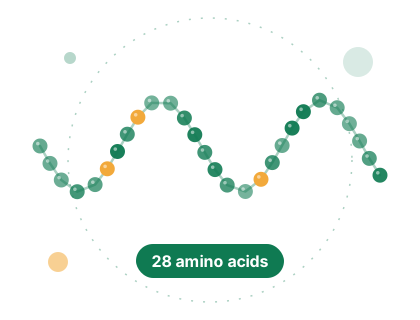
Thymosin alpha 1 is a 28-amino-acid immune peptide, sold abroad as thymalfasin (Zadaxin), and it is not FDA-approved. It is licensed in some countries for hepatitis B or as a vaccine aid. A 1,106-patient sepsis trial found no survival benefit, an FDA panel voted against compounding it in 2024, and HHS's 2026 policy does not cover it.
- What it is
- A synthetic 28-amino-acid peptide first isolated from cattle thymus extract, marketed outside the US as thymalfasin (Zadaxin) to modify immune responses.
- FDA status
- Not FDA approved
Not FDA-approved for any use. Placed in 503A category 2 on September 29, 2023; nomination later withdrawn. PCAC voted against the acetate 4 to 17 on December 4, 2024. In no 503A category on the May 14, 2026 list, and not among the six peptides in HHS's October 2026 enforcement policy.
- Evidence level
Phase 3 trials
Large randomized human trials have been completed.
Thymosin alpha 1 is an immune-modulating peptide that is licensed as a drug in several countries and has never been approved in the United States. Outside the US it is sold as thymalfasin (Zadaxin). In the peptide index it has one of the deeper trial records, including a large phase 3 trial, and that trial was negative. Vials labeled “for research use only” are not legal to use on people, and as of November 2, 2026 it has no lawful US compounding route.
| Quick answer | Thymosin alpha 1 |
|---|---|
| Also called | Thymalfasin, Ta1, thymosin alfa 1; Zadaxin is a finished drug sold abroad |
| What it is | Synthetic peptide of 28 amino acids |
| FDA status | Not approved for any use |
| Licensed abroad for | Mainly chronic hepatitis B, and in Italy as an aid to flu vaccination in people with weak immune systems |
| Biggest trial | TESTS, 1,106 adults with sepsis: 23.4% died vs 24.1% on placebo |
| FDA advisory committee | Voted against adding it to the compounding list, December 4, 2024 |
| HHS October 2026 policy | Not covered |
| Established US dose | None |
What is thymosin alpha 1?
Thymosin alpha 1 is a chain of 28 amino acids, first isolated from an immunologically active extract of cattle thymus. The thymus is the small gland behind the breastbone where T cells, a type of immune cell, mature. FDA dates the discovery to 1977, and the peptide later became available in synthetic form.
The names cause confusion, and FDA is careful about them. Thymalfasin is the chemically made version of thymosin alpha 1, so those two names are used interchangeably. Zadaxin is a specific finished product, a 1.6 mg powder for injection, and it cannot be treated as the same thing as a vial labeled “Ta1” from another source. Thymosin alpha 1 free base and thymosin alpha 1 acetate also count as different ingredients.
It has nothing to do with TB-500, despite the name. TB-500 comes from thymosin beta-4, a different protein.
How does thymosin alpha 1 work?
In lab and animal studies, thymosin alpha 1 activates Toll-like receptors, the sensors immune cells use to detect threats, on dendritic cells and lymphoid progenitor cells. That is why it gets called an immune modulator. FDA cautions that the clinical meaning is hard to judge: doses and routes varied across studies, most animal doses were far higher than those used in people, and the concentrations that blocked HIV in a dish were 2,000 times the peak blood level from a usual human dose.
After an injection under the skin, blood levels peak at about 2 hours and the half-life is also about 2 hours, with no build-up on repeated once-daily dosing in a small study of 9 healthy people.
Where is thymosin alpha 1 approved?
Thymosin alpha 1 is licensed outside the United States, and the approved uses differ by country. This is what FDA’s December 2024 review found:
| Place | What FDA’s review describes |
|---|---|
| Italy | Zadaxin authorized as an aid to flu vaccination in people with weakened immune systems |
| India | Injection for chronic hepatitis B in adults with compensated liver disease and active viral replication |
| Indonesia | Zadaxin registered for chronic hepatitis B in adults with compensated liver disease |
| Hong Kong | Approved; FDA’s review does not list the indication |
| Singapore | A monograph lists chronic hepatitis B and C |
| Mexico | A monograph lists chronic hepatitis B, alone or with interferon, and flu vaccination in people with weak immune systems |
| Asia-Pacific, Latin America, Eastern Europe, Middle East | Claimed in the maker’s 2014 annual report |
FDA added that it could not independently verify the maker’s claims about approvals in those regions, and that it did not know how widely the drug is used today. You will see much larger country counts online. We could not confirm them from a primary source, so we do not repeat them. The European Medicines Agency granted orphan designation for liver cancer, which is an incentive, not an authorization. There is no monograph in the European or Japanese pharmacopoeias.
Thymosin alpha 1 in the United States
Thymosin alpha 1 is not approved in the United States, and its compounding record is a string of no’s.
| Date | What happened |
|---|---|
| September 29, 2023 | FDA placed thymosin alpha-1 (Ta1) in 503A category 2, substances that raise significant safety risks. |
| Before December 2024 | The nomination was withdrawn. FDA chose to evaluate the free base and the acetate on its own initiative. |
| December 4, 2024 | FDA staff proposed against listing either form, for 12 proposed uses. The advisory committee voted 4 to 17 against the acetate, and a majority also voted against the free base. |
| April 22, 2026 | FDA’s safety-risk page lists it under “nominated but withdrawn,” with the warning that it “may pose significant risk for immunogenicity.” |
| May 14, 2026 | FDA’s category list shows it in no category. |
| October 2026 | HHS said it does not intend to act against compounding of six peptides under ten conditions. Thymosin alpha 1 is not one of the six. |
FDA said there is no USP monograph for it and that it is not a component of an FDA-approved drug. Both matter, because section 503A requires a monograph, an approved-drug component, or a place on the bulks list. Thymosin alpha 1 has none of the three as of November 2, 2026. It does hold four US orphan drug designations, but FDA stresses that those only give sponsors incentives and do not mean a drug has been approved.
Does thymosin alpha 1 work?
The evidence is broad but weak, and the best trial was negative. FDA looked at 12 uses and concluded there was a lack of evidence of effectiveness for all of them. In its words, the studies “were inconclusive and limited by small sample sizes and design deficiencies.” For uses with US clinical guidelines, the guidelines do not mention it.
| Use | Best evidence described | Conclusion |
|---|---|---|
| Sepsis | TESTS, double-blind phase 3, 1,106 adults: 23.4% vs 24.1% died by day 28 | No clear evidence of benefit |
| Chronic hepatitis B | Many small trials with mixed results; 2016 Asian guidelines no longer recommend it | Insufficient. Approved antivirals exist |
| Chronic hepatitis C | Cure rates of 0 to 52% in older studies | FDA found it inferior to current antivirals |
| HIV | Five studies, none showing effects on AIDS-defining illness, death or viral load | Insufficient |
| COVID-19 | Three of four meta-analyses found no drop in deaths | Insufficient |
| Flu vaccine response | Higher antibody levels in some groups, with variable results | Insufficient |
| Liver cancer | Two randomized trials with no difference from control | Insufficient |
| Melanoma | One phase 2 randomized trial showed no significant difference in the main analysis | Insufficient |
| Lung cancer | Studies with design limits | Insufficient |
| COPD | Small, short studies | Lack of evidence |
| Chronic fatigue syndrome | No clinical studies found | Lack of evidence |
The sepsis story
Sepsis shows how a promising signal can disappear in a better trial. In the ETASS trial of 361 patients, published in 2013, deaths at 28 days were 26% on thymosin alpha 1 and 35% in the control group, a difference that narrowly missed statistical significance. That trial was single-blind. TESTS, published in the BMJ in January 2025, was larger, double-blind and placebo-controlled, across 22 centers in China from 2016 to 2020. It found no overall benefit. Safety outcomes did not differ between groups. In a subgroup analysis, results looked worse in people under 60 and better in people with diabetes, which is a lead for further study and not proof of either. TESTS appeared after FDA’s December 2024 review, so it was not part of that record.
All the sepsis studies FDA reviewed came from outside the US, so applying them to US care adds another layer of uncertainty.
What about hepatitis B?
Hepatitis B is where thymosin alpha 1 has its strongest regulatory footing, and even there it has lost ground. Earlier Asian guidelines recommended it as an alternative to interferon. The 2016 version only acknowledges it as licensed in some Asian countries, without recommending it. It is not a recommended therapy in current US guidelines. FDA warned that using it in place of, or delaying, an approved antiviral “could have serious negative sequelae” for someone living with chronic hepatitis B. FDA points to approved drugs with established efficacy for chronic hepatitis B.
What results should you expect?
No study supports any expected result for general “immune support,” which is how thymosin alpha 1 is mostly marketed in the US. FDA found compounded products promoted for hepatitis, HIV, chronic fatigue, sepsis, COVID-19, Lyme disease, allergies, cancer, asthma, COPD and psoriatic arthritis. It found no published study of a compounded product in people at all. Trials measured specific outcomes in sick patients, not how healthy people feel, and no timeline exists for feeling better.
Thymosin alpha 1 side effects
In most trials, thymosin alpha 1 was well tolerated, and the most common problems were at the injection site: local irritation, redness and discomfort. That reassuring picture comes with limits, because safety reporting in many studies was thin. FDA’s database search through June 2024 found one applicable report: a man with hepatitis C on peginterferon and thymosin alpha 1 who was hospitalized with atrial fibrillation and anxiety, where peginterferon was a likely confounder.
| Possible problem | What was seen |
|---|---|
| Liver enzyme flares | 22 temporary flares among 316 people with hepatitis B in one study; therapy paused in 16; all recovered |
| Thyroid changes | Two people on thymosin alpha 1 with interferon had temporary shifts in thyroid hormone |
| Nipple pain | Over 10% of treated patients in one liver cancer study |
| Stem cell transplant | One of six recipients developed a fatal immune anemia after thymosin alpha 1 and donor cells; FDA could not tell whether the peptide contributed |
| Immune reaction to the peptide | FDA says a 28-amino-acid peptide given under the skin “may pose a significant risk for immunogenicity” |
The compounded version adds its own risk. The nominated product was 3 mg/mL, while the highest strength FDA found in clinical trials was 2 mg/mL. More concentrated solutions may clump, which can raise the chance of an immune reaction. FDA also could not see how that strength would dissolve, given the peptide’s limited solubility.
Is there a thymosin alpha 1 dosage?
No dose has been established for use in the United States. The most common dose in clinical studies was 1.6 mg under the skin, usually on a twice-weekly schedule, and foreign labels set their own schedules for their approved conditions under medical care. Those facts describe trials and foreign labels, not advice. People often search for a dose to use when sick, and no trial has tested that. A cold or flu at home is nothing like the settings where this peptide was studied.
The research-market version is a separate problem. Under 21 CFR 312.160, a research-use label permits shipment only for laboratory animal or test-tube work. A vial sold that way has no verified identity, strength or sterility, and the COA guide explains why a seller’s certificate does not fix that.
Who should avoid thymosin alpha 1
Foreign labels and FDA’s review point to these groups:
- Children. Italy’s label says it should not be used in children.
- Pregnancy and breastfeeding. Contraindicated on Italy’s label.
- Deliberate immune suppression. Indonesia’s label says to treat it as contraindicated in people such as organ transplant recipients unless benefit clearly outweighs risk.
- Stem cell transplant. FDA says it is unclear whether it could cause or worsen graft-versus-host disease, or lead to graft failure.
- Autoimmune disease. Italy’s label says use should be weighed case by case.
- Allergy or atopy. Italy’s label advises caution in people with allergic conditions.
- Other immune-acting medicines. Italy’s label advises caution when combined.
- Vaccine plans. FDA says the safety of pairing it with US-licensed flu vaccines has not been adequately assessed.
How does it compare, and what about cost?
Thymosin alpha 1 has no US price because it has no lawful US product. We do not list prices or sources for unapproved peptides. It is also not a substitute for treatment: FDA says approved drugs exist for many of the conditions it reviewed, including chronic hepatitis B and lung cancer. Sepsis has no drug approved for the condition as a whole, and care relies on antibiotics, fluids and blood-pressure support in a hospital. Nothing about that care should wait for a peptide.
If you want to compare it with other immune or recovery peptides, see TB-500 and the broader guide to peptide therapy.
Is thymosin alpha 1 banned in sport?
It is not named on the 2026 WADA Prohibited List, which does name thymosin-beta-4 and its derivatives such as TB-500. Class S0 covers substances with “no current approval by any governmental regulatory health authority for human therapeutic use,” and thymosin alpha 1 has approvals abroad, so its position is not obvious. An athlete subject to testing should ask their national anti-doping organization.
Questions to ask a prescriber
- What condition are we treating, and is there an approved drug for it?
- If I have hepatitis, how would this fit with my antiviral treatment?
- Do I have an autoimmune disease or take anything that suppresses my immune system?
- Am I pregnant, breastfeeding or planning a vaccine soon?
Status changes are logged on the FDA status tracker, and are peptides safe covers the broader risks of compounded and research-market peptides.
Compare
- PeptidesNot FDA approvedTB-500TB-500 is a seven-amino-acid fragment of thymosin beta-4, and FDA found no human use data on it.
- LearnFDA status trackerWhich peptides are FDA-approved, which HHS tolerates under conditions, and which are not legal to use.
- LearnAre peptides safe?Approved peptide drugs have measured risks.
Peptide news, sorted. Plus the printable dose chart.
Sorted, every Tuesday: the week's peptide and GLP-1 news in five minutes: FDA moves, new studies explained, and price changes. Subscribe and the one-page dose and injection-site chart arrives first.
Questions people ask
What does thymosin alpha 1 do?
Is thymosin alpha 1 FDA-approved?
Where is Zadaxin approved?
What is the thymosin alpha 1 dosage when sick?
Is thymosin alpha 1 the same as TB-500?
Does thymosin alpha 1 work for sepsis?
Sources
Primary sources first: FDA labels and documents, peer-reviewed trials, registries.
- 1FDA. Briefing document: evaluation of thymosin alpha-1-related bulk drug substances, Pharmacy Compounding Advisory Committee, December 4, 2024fda.gov
- 2FDA. Final summary minutes of the Pharmacy Compounding Advisory Committee meeting, December 4, 2024fda.gov
- 3Wu J et al. The efficacy and safety of thymosin alpha 1 for sepsis (TESTS): multicentre, double blinded, randomised, placebo controlled, phase 3 trial. BMJ 2025;388:e082583bmj.com
- 4FDA. Certain bulk drug substances for use in compounding may present significant safety risks (content current as of April 22, 2026)fda.gov
- 5FDA. 503A categories update, September 29, 2023 (copy hosted by the Alliance for Pharmacy Compounding)join.a4pc.org
- 6FDA. Bulk drug substances nominated for use in compounding under section 503A, category list (updated May 14, 2026)fda.gov
- 7HHS. Enforcement Discretion Policy Regarding 503A Compounding Using Certain Peptide Bulk Drug Substances, with Appendices A and B, October 2026hhs.gov
- 8WADA 2026 Prohibited List, official text as reprinted in the Dutch Treaty Series (Trb. 2026, 25)zoek.officielebekendmakingen.nl
- 921 CFR 312.160, drugs for investigational use in laboratory research animals or in vitro testslaw.cornell.edu
PeptideSorted Editorial Team
Editorial review
The PeptideSorted editors check every guide against its cited sources before publication: each number against its FDA label, trial or registry, the FDA status against current FDA and HHS documents, and the wording against our describe-never-prescribe rule. Licensed clinicians who join the review panel are listed by name on the editorial team page.
This page was checked against its cited sources by the PeptideSorted editorial team. Licensed clinicians on our review panel are listed on the editorial team page. Every health page cites primary sources and shows its review date. Read the editorial policy and how medical review works, or report an error via corrections. Educational only; not medical advice.