
Short answer
Measured before-and-after changes with sermorelin are modest. Children with growth hormone deficiency roughly doubled their growth rate within six months. In healthy older adults, studies of 19 people or fewer found IGF-1 rose on some regimens, lean mass rose in men only in one study, and body fat and sleep did not improve. No study tested appearance.
- What it is
- A synthetic 29-amino-acid fragment of human growth hormone-releasing hormone that prompts the pituitary to release growth hormone.
- FDA status
- Compounded (Rx)
No sermorelin product is FDA-approved today. Geref was approved for children in 1997 and withdrawn in 2009, not for safety or effectiveness; pharmacies compound it with a prescription.
- Evidence level
Early human studies
Small or uncontrolled human studies only.
Sermorelin results look much smaller in controlled studies than in clinic photos. The adult studies enrolled 19 people or fewer and lasted between two and sixteen weeks. They measured blood hormones, body composition scans and questionnaires, and found modest changes in some of them. The biggest measured change belongs to children with growth hormone deficiency, whose growth rate roughly doubled. No sermorelin product is FDA-approved today, and what is prescribed now is compounded. If you came here wondering what a person might look like after three months, no study can tell you.
What the controlled studies measured
| Study | Who and how many | Dose and length | Before vs after: what changed | What did not change |
|---|---|---|---|---|
| Thorner et al. 1996 | 110 children with GH deficiency (86 analysed); no placebo group | 30 mcg/kg nightly, up to 1 year | Height velocity 4.1 cm/yr at baseline, 8.0 at 6 months, 7.2 at 12 months | Fasting glucose; no excess IGF-1 |
| Corpas et al. 1992 | 10 healthy older men (about 68), plus 9 young men for comparison | 0.5 mg or 1 mg twice daily, 14 days each | At 1 mg: 24-hour GH and IGF-1 rose to young men’s levels | At 0.5 mg, changes did not reach significance; body composition not measured |
| Vittone et al. 1997 | 11 healthy men aged 64 to 76; no placebo group | 2 mg nightly, 6 weeks | Night-time GH; two of six strength tests and one endurance test improved | IGF-1, weight, waist-to-hip ratio, DEXA muscle and fat, glucose, lipids |
| Khorram et al. 1997 | 19 adults aged 55 to 71 (10 women, 9 men); single-blind, 4 weeks of placebo first | A close analogue, 10 mcg/kg nightly, 16 weeks | IGF-1 up within 2 weeks, back toward baseline by 16 weeks; skin thickness up in both sexes; lean mass, insulin sensitivity, well-being and libido up in men only | Body weight, other body composition, bone density, sleep quality; no changes in women apart from skin thickness and hormones |
| Khorram et al. 1997 (immune arm, same participants) | 19 adults | Same | IGF-1 up 28%; several immune-cell counts and responses rose | T-cell and natural killer cell numbers |
| Murck et al. 1997 | 2 healthy older men, sleep laboratory | GHRH 100 mcg IV every second day for 12 days, then 4 x 50 mcg overnight | ACTH (a stress-axis hormone) rose | No sleep improvement; slow-wave sleep fell |
The Khorram studies used [Nle27]GHRH(1-29), an analogue that differs from sermorelin at one position, and the Murck study used GHRH without specifying the form, so neither is a test of sermorelin itself. They are included because they are among the few controlled adult studies of this drug class that measured body composition or sleep.
What the numbers add up to
Hormones move, bodies barely do. The most consistent finding is that growth hormone rises with dosing. IGF-1, the hormone that carries many of growth hormone’s effects to tissues, rose with twice-daily dosing and with the Khorram analogue but not with a single 2 mg nightly dose. Changes in muscle and fat were small and appeared in men only, in one study.
Effects wore off. In Khorram 1997, IGF-1 drifted back toward baseline by week 16 while dosing continued.
Sleep did not improve. The two adult studies that looked at sleep found no benefit. This matters because better sleep is one of the most common claims made for sermorelin online.
Children are a different case. The clearest before-and-after result is growth in children who lacked growth hormone, which is what Geref was approved for. Even there, the 1999 BioDrugs review notes the gain was smaller than with growth hormone itself.
Nobody tested appearance or weight loss. No published controlled study of sermorelin used weight loss, waist size or photographs as its main outcome.
Sermorelin results timeline: what was measured and when
Sermorelin results in the studies show up in blood tests first, and there is no week-by-week record of how a body looks. Here is everything measured, in order.
| When | What was measured | Who |
|---|---|---|
| 5 to 20 minutes after injection | Peak blood level of sermorelin itself | 12 volunteers, Geref text |
| Week 2 | IGF-1 up on 1 mg twice daily, and on the close analogue | Older men (Corpas); older adults (Khorram) |
| Week 6 | Night-time GH up on 2 mg nightly; IGF-1 and DEXA body composition unchanged | Older men (Vittone) |
| Week 12 | IGF-1 still raised | Older adults (Khorram) |
| Week 16 | IGF-1 back toward baseline, despite continued dosing | Older adults (Khorram) |
| Month 6 | Growth 8.0 cm a year, up from 4.1 | Children with GH deficiency (Thorner) |
| Month 12 | Growth 7.2 cm a year | Children with GH deficiency (Thorner) |
Week 6 is the most useful row for an adult wondering about body fat. Vittone is the only study here that scanned body composition on sermorelin itself, and it found no change. A longer course might behave differently, but we found no study that tested it.
Results in men and women
Sermorelin has barely been studied in women. The Corpas and Vittone studies enrolled men only, so the only women in these adult studies are the 10 in Khorram 1997, who received a close analogue. They had a rise in skin thickness and in hormone levels, with no change in lean mass, well-being or libido. Men in the same study gained lean mass and reported better well-being and libido. The authors called for more work to explain the difference, and a study of 19 people cannot settle it. Claims that sermorelin gives women a particular result rest on no controlled data we could find.
After you stop
The one measured result on stopping comes from children, not adults. In Kirk 1994, 18 short children without growth hormone deficiency were recruited for a year of twice-daily treatment. In the three months after it ended, growth dropped to 3.89 cm a year, a slowdown the authors called catch-down growth. Whether adults keep any change after stopping is unknown, since none of the adult studies here reported follow-up after treatment ended.
Why before-and-after photos are not evidence
A before-and-after photo answers a different question from a trial. A trial asks: compared with people who did not get the drug, what changed? A photo can only show that someone looks different on two days. Reasons a photo can show a change that the drug did not cause:
- No comparison group. Most people who start a peptide also change diet, training, sleep or alcohol at the same time. A photo cannot separate those.
- Other drugs. Compounded sermorelin is often prescribed alongside other hormones or blended with other peptides. FDA’s 2024 ipamorelin briefing documented compounded vials combining sermorelin and ipamorelin.
- Lighting, pose and timing. Overhead versus side light, a flexed versus relaxed posture, a morning versus evening photo, and water retention all change how a body looks within a single day.
- Selection. Clinics and sellers publish the best results they have. The people with no change are not photographed.
- The studies point the other way. The one study that scanned body fat with DEXA after six weeks of 2 mg nightly found no change.
None of this means nobody feels or looks different. It means a photo cannot tell you whether sermorelin was the reason, and the controlled data that can tell you show small effects.
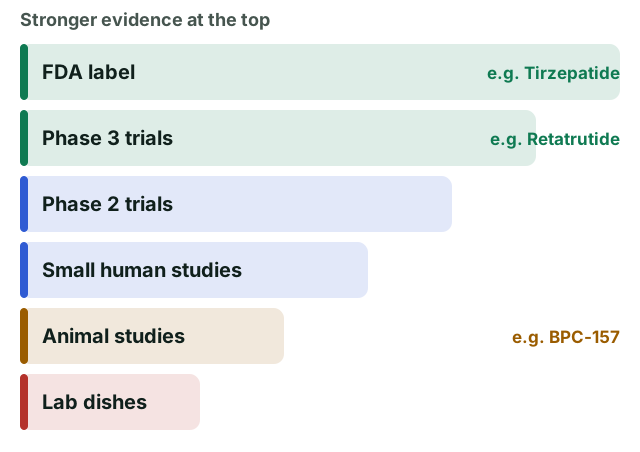
Sermorelin’s adult data sit on the small-human-studies rung. A photo is not on the ladder at all.
How to judge a result someone shows you
If a clinic or a friend shows you a transformation, a few questions separate a real signal from a good picture:
- Was there a blood test before and after, and did IGF-1 actually change?
- Were sermorelin and nothing else used? Ask about testosterone, GLP-1 drugs and other peptides.
- Did diet or training change in the same months?
- Was the body composition measured with a scan, or judged by eye?
- How many patients did not get a result like this one?
- Is the person showing it to you selling the treatment?
For your own decision, tracking measurable things with a prescriber tells you more than a mirror. The sermorelin side effects guide covers the tests and warning signs that belong in that conversation, and sermorelin vs tesamorelin shows what a large, placebo-controlled trial of a related drug looks like.
Status and legality
No sermorelin product is FDA-approved today. Geref was approved for children with growth hormone deficiency in 1997, discontinued in 2008 and withdrawn in 2009, and FDA determined in 2013 that the withdrawal was not for safety or effectiveness. FDA wrote in 2024 that no growth hormone secretagogue has been approved for growth hormone deficiency in adults. Pharmacies compound sermorelin with a prescription; research-only vials sold online are not legal to use on people. For doses used in each study see sermorelin dosage, and for the current legal position see the FDA status tracker.
Compare
- PeptidesCompounded (Rx)SermorelinSermorelin signals the pituitary to release growth hormone.
- PeptidesCompounded (Rx)DosageThe only approved sermorelin dose was 30 mcg/kg nightly in children.
- PeptidesCompounded (Rx)Side effectsThe most common sermorelin side effect is an injection site reaction, in about 1 in 6 patients.
Peptide news, sorted. Plus the printable dose chart.
Sorted, every Tuesday: the week's peptide and GLP-1 news in five minutes: FDA moves, new studies explained, and price changes. Subscribe and the one-page dose and injection-site chart arrives first.
Questions people ask
How long does sermorelin take to work?
Does sermorelin cause fat loss?
Does sermorelin improve sleep?
Are sermorelin before and after photos reliable?
Do sermorelin results differ between men and women?
What happens after stopping sermorelin?
Sources
Primary sources first: FDA labels and documents, peer-reviewed trials, registries.
- 1Thorner M et al. Once daily subcutaneous GHRH therapy accelerates growth in GH-deficient children during the first year of therapy. J Clin Endocrinol Metab 1996pubmed.ncbi.nlm.nih.gov
- 2Corpas E et al. GHRH(1-29) twice daily reverses the decreased GH and IGF-I levels in old men. J Clin Endocrinol Metab 1992pubmed.ncbi.nlm.nih.gov
- 3Vittone J et al. Effects of single nightly injections of GHRH (GHRH 1-29) in healthy elderly men. Metabolism 1997pubmed.ncbi.nlm.nih.gov
- 4Khorram O et al. Endocrine and metabolic effects of long-term administration of [Nle27]GHRH-(1-29)-NH2 in age-advanced men and women. J Clin Endocrinol Metab 1997pubmed.ncbi.nlm.nih.gov
- 5Khorram O et al. Effects of [Nle27]GHRH-(1-29)-NH2 administration on the immune system of aging men and women. J Clin Endocrinol Metab 1997pubmed.ncbi.nlm.nih.gov
- 6Murck H et al. Longtime administration of GHRH does not restore the reduced efficiency of GHRH on sleep endocrine activity in 2 old-aged subjects. Pharmacopsychiatry 1997pubmed.ncbi.nlm.nih.gov
- 7Kirk JM et al. Treatment with GHRH(1-29)NH2 in children with idiopathic short stature induces a sustained increase in growth velocity. Clin Endocrinol 1994pubmed.ncbi.nlm.nih.gov
- 8Prakash A, Goa KL. Sermorelin: a review of its use in the diagnosis and treatment of children with idiopathic growth hormone deficiency. BioDrugs 1999pubmed.ncbi.nlm.nih.gov
- 9Sermorelin acetate prescribing text, FDA revision date October 2, 2001, as reproduced by RxListrxlist.com
- 10FDA. Briefing document on ipamorelin-related bulk drug substances, Pharmacy Compounding Advisory Committee, October 29, 2024fda.gov
- 11Federal Register. Determination that Geref (sermorelin acetate) injection was not withdrawn from sale for reasons of safety or effectiveness. 78 FR 14095, March 4, 2013govinfo.gov
More on Sermorelin
- OverviewSermorelinSermorelin signals the pituitary to release growth hormone. Geref was FDA-approved for children; today it is compounded only. Benefits, risks and evidence.
- DosageThe only approved sermorelin dose was 30 mcg/kg nightly in children. No adult dose was ever approved. What each study used, plus the syringe arithmetic.Read
- Side effectsThe most common sermorelin side effect is an injection site reaction, in about 1 in 6 patients. Rates from the Geref text, thyroid risks and red flags.Read
- Vs tesamorelinTesamorelin has FDA approval and two large trials, for HIV-related belly fat only. Sermorelin has no approved product. Evidence, doses and risks compared.Read
PeptideSorted Editorial Team
Editorial review
The PeptideSorted editors check every guide against its cited sources before publication: each number against its FDA label, trial or registry, the FDA status against current FDA and HHS documents, and the wording against our describe-never-prescribe rule. Licensed clinicians who join the review panel are listed by name on the editorial team page.
This page was checked against its cited sources by the PeptideSorted editorial team. Licensed clinicians on our review panel are listed on the editorial team page. Every health page cites primary sources and shows its review date. Read the editorial policy and how medical review works, or report an error via corrections. Educational only; not medical advice.