
Short answer
Tesamorelin has much stronger evidence than sermorelin, but only for one use. It is FDA-approved as Egrifta to reduce excess abdominal fat in adults with HIV and lipodystrophy, based on two placebo-controlled trials. Sermorelin's only approval, for children with growth hormone deficiency, was withdrawn in 2009, and it is now only compounded. No trial has compared them.
- What it is
- A comparison of two synthetic growth hormone-releasing hormone analogues: sermorelin (GHRH 1-29) and tesamorelin (modified GHRH 1-44).
- FDA status
- Compounded (Rx)
Sermorelin: Geref approvals withdrawn June 18, 2009, not for safety or effectiveness; compounded only. Tesamorelin: Egrifta approved November 10, 2010 for excess abdominal fat in HIV-associated lipodystrophy.
- Evidence level
Early human studies
Small or uncontrolled human studies only.
Tesamorelin has the far stronger evidence and the only current FDA approval, but that approval covers one narrow use. Sermorelin and tesamorelin are close relatives, both synthetic versions of growth hormone-releasing hormone (GHRH), the brain signal that tells the pituitary to release growth hormone. Both are injected under the skin. Tesamorelin is an FDA-approved drug with a current label; sermorelin’s only approval, for children, was withdrawn in 2009, and what is prescribed now is compounded. If you have HIV-related abdominal fat, the evidence points clearly to tesamorelin. If you do not, neither drug has good evidence for you. The tesamorelin guide covers that drug in full.
Side by side
| Sermorelin | Tesamorelin | |
|---|---|---|
| Structure | First 29 amino acids of human GHRH, GHRH(1-29)NH2 | All 44 amino acids of human GHRH plus a hexenoyl group (a six-carbon chain) on the first amino acid, prepared as an acetate salt |
| Brand | Geref (discontinued) | Egrifta WR (11.6 mg vial); earlier Egrifta and Egrifta SV formulations |
| FDA status | Approved 1990 (diagnostic) and 1997 (children with GH deficiency); approvals withdrawn June 18, 2009, not for safety or effectiveness. No approved product today; compounded only. | Approved November 10, 2010. Current label |
| Approved use | Former: idiopathic GH deficiency in children with growth failure, and a diagnostic test | Reduction of excess abdominal fat in HIV-infected adults with lipodystrophy. Not for weight loss |
| Key trials | Open-label study of 110 children for up to 1 year; adult studies of 10 to 19 people for 2 to 16 weeks | Two randomized, double-blind, placebo-controlled trials of 412 and 404 patients for 26 weeks, each with a 26-week extension |
| Main result | Children’s height velocity rose from 4.1 to 8.0 cm/yr at 6 months. Adults: GH and sometimes IGF-1 rose; body composition changed little | Visceral (deep belly) fat fell 18% vs a 2% rise on placebo in Study 1, and 14% vs 2% fall in Study 2 |
| Dose in label or studies | Geref: 30 mcg/kg once daily at bedtime (children). Adult studies: 1 mg twice daily or 2 mg nightly | Egrifta WR: 1.28 mg once daily. Egrifta SV: 1.4 mg once daily. Trials: 2 mg once daily of the original 1 mg/vial formulation |
| Half-life | 11 to 12 minutes (reproduced Geref text) | About 11 minutes in healthy subjects (label) |
| Reaches the bloodstream | About 6% after injection under the skin (reproduced Geref text) | Less than 4% after injection under the skin (label) |
| Common side effects | Injection site reactions, about 1 patient in 6; flushing and headache under 1% | Injection site reactions, joint pain, limb pain, muscle pain, swelling of the legs, tingling or numbness |
| Label warnings | No current label | Possible tumor growth in people with cancer history, raised IGF-1, fluid retention, glucose intolerance or diabetes, hypersensitivity, injection site reactions, higher mortality in acute critical illness |
| WADA | Prohibited, class S2 | Prohibited, class S2 |
How they work, and why the structure differs
Sermorelin and tesamorelin work at the same step: both copy GHRH at the pituitary, which then releases growth hormone and raises IGF-1 (insulin-like growth factor 1).
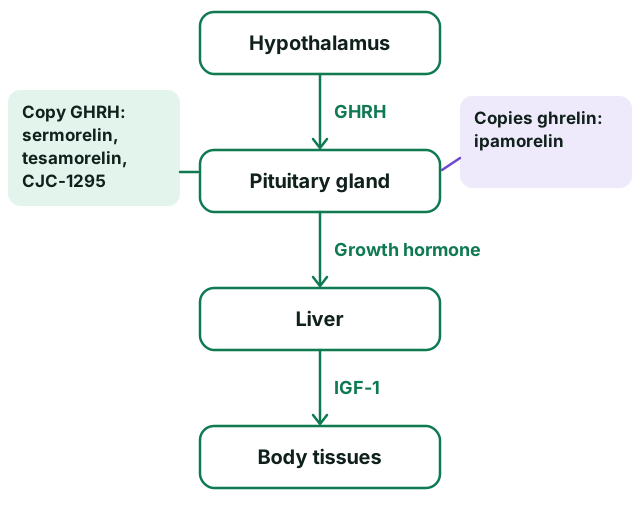
A 2005 study by the original maker of Geref noted that the clinical use of GHRH is limited by its short half-life. Sermorelin keeps the shortest part of the molecule that still has full activity. Tesamorelin keeps all 44 amino acids and adds a hexenoyl group to the first one, and a 2012 trial describes it as a stabilized GHRH analog. Even so, the half-lives on paper look alike: about 11 minutes for tesamorelin and 11 to 12 minutes in the reproduced Geref text. Those numbers came from different studies and doses, so they should not be read as a head-to-head result. The tesamorelin label and the old Geref regimen both used one injection a day.
Which has better evidence?
Tesamorelin was tested in a specific population: adults with HIV whose antiretroviral treatment had redistributed fat to the abdomen. In two 26-week trials, 2 mg daily reduced visceral fat measured by CT scan. In Study 1, mean visceral fat changed by minus 27 cm² versus plus 4 cm² on placebo; in Study 2, minus 21 versus about zero. Trunk fat fell by 0.8 to 1.0 kg and lean body mass rose by 1.2 to 1.3 kg. The label notes the drug is weight neutral and that long-term cardiovascular safety has not been established.
Sermorelin was tested for growth in children with growth hormone deficiency, where it worked but less well than growth hormone, and in a handful of small studies in healthy older adults, where it raised hormone levels but did little measurable to body composition. We found no sermorelin trials in HIV lipodystrophy and no large adult trials of any kind. The sermorelin before and after guide lists each study.
No trial has compared the two drugs directly.
Who each one suits
Tesamorelin fits one group by label: adults with HIV and lipodystrophy who carry excess abdominal fat. The trials enrolled people aged 18 to 65 with a large waist measurement and fasting glucose under 150 mg/dL, and they excluded people with a history of cancer or hypopituitarism, and those with diabetes on glucose-lowering treatment. Use outside that description is off-label.
Sermorelin fits no current approved group. Its history is in children with idiopathic growth hormone deficiency, where growth hormone itself did more. Adults who receive it are getting a compounded, off-label product.
For an adult without HIV who is curious about either drug for fat loss, muscle or aging, the honest position is that neither has been shown to help. Tesamorelin’s 2012 trial in older adults without HIV looked at thinking and memory, not body shape, as its main goal, and found mild adverse events in 68% versus 36% on placebo.
Dosing in the label and studies
These are what the label and studies used, not recommendations. Tesamorelin’s current label dose depends on the formulation: Egrifta WR is 1.28 mg (0.16 mL after mixing an 11.6 mg vial with 1.3 mL of bacteriostatic water, giving 8 mg/mL) once daily into the abdomen, and the label states that Egrifta WR and Egrifta SV are not substitutable. The phase 3 trials used 2 mg daily of the older 1 mg/vial product. Sermorelin’s former Geref dose was weight-based for children, and the adult studies used fixed doses. No conversion exists between the two drugs, so a sermorelin dose cannot be translated into a tesamorelin dose or the reverse. See sermorelin dosage and tesamorelin dosage for the detail and the unit arithmetic.
Side effects
The tesamorelin label pools 543 patients on drug and 263 on placebo during the 26-week phase. Injection site reactions were reported by 17% versus 6%, arthralgia (joint pain) by 13% versus 11%, pain in an arm or leg by 6% versus 5%, myalgia (muscle pain) by 6% versus 2%, and peripheral edema (swelling) by 6% versus 2%. The label tells prescribers to check glucose before and during treatment, monitor IGF-1, and consider stopping if IGF-1 stays high. It is contraindicated in pregnancy, active cancer, disorders of the hypothalamic-pituitary axis and known hypersensitivity.
Sermorelin’s side-effect data come from children on Geref and small 1990s adult studies. The 1999 BioDrugs review reports it was well tolerated, with transient facial flushing and injection site pain the most common events. Because there is no current label, there is no FDA-reviewed list of warnings, but the same biology applies: anything that raises growth hormone and IGF-1 raises the same questions about glucose, fluid retention and cancer. Sermorelin’s own record adds hypothyroidism in 6.5% of patients during studies. The sermorelin side effects guide has the full list.
Legality, cost and access
Tesamorelin is a prescription drug dispensed by licensed pharmacies. Drugs.com lists a cash price of about $2,610 for 30 of the 2 mg vials, roughly a month of Egrifta SV, and the manufacturer runs assistance programs for qualifying patients. We found no equivalent reference price for Egrifta WR. Sermorelin can be obtained legally only as a compounded preparation from a licensed pharmacy with a prescription; FDA’s 503B list identifies sermorelin acetate as a component of an FDA-approved drug, which is the basis pharmacies rely on. We do not quote a sermorelin price, because the only figures we found came from clinics and sellers.
Compounding runs the other way for tesamorelin. Egrifta became a biological product in March 2020, and FDA says transitioned products are not eligible for the 503A and 503B compounding exemptions. A compounded sermorelin product has no FDA label and no FDA review of its quality. Neither drug is on the interim HHS peptide policy announced October 28, 2026, which covers six other peptides, so as of November 2, 2026 that policy changes nothing here and approves nothing. Vials of either sold for research use only are not legal to use on people. Both drugs are prohibited at all times under class S2 of the 2026 WADA Prohibited List. The FDA status tracker keeps both entries current.
What this comparison cannot tell you
- Which is stronger. Nobody has measured the two against each other, in any population.
- Whether tesamorelin’s results apply to you without HIV. The trial population was narrow, and its fat distribution was the condition being treated.
- Whether sermorelin would reduce visceral fat. It has not been tested in the people or the way tesamorelin was. Its DEXA study lasted 6 weeks.
- Long-term safety of either. The tesamorelin label says long-term cardiovascular safety has not been established, and sermorelin’s adult studies stopped by 16 weeks.
- How a compounded vial compares with the study drug. Studies used pharmaceutical products, and a compounded product has no FDA review of its quality.
Compare
- PeptidesCompounded (Rx)SermorelinSermorelin signals the pituitary to release growth hormone.
- PeptidesFDA approvedTesamorelinTesamorelin (Egrifta) is FDA-approved only for excess belly fat in adults with HIV.
- PeptidesCompounded (Rx)DosageThe only approved sermorelin dose was 30 mcg/kg nightly in children.
Peptide news, sorted. Plus the printable dose chart.
Sorted, every Tuesday: the week's peptide and GLP-1 news in five minutes: FDA moves, new studies explained, and price changes. Subscribe and the one-page dose and injection-site chart arrives first.
Questions people ask
Is tesamorelin better than sermorelin?
Which is better for belly fat, sermorelin or tesamorelin?
Is tesamorelin FDA-approved for weight loss?
Can a doctor prescribe tesamorelin for other uses?
What are the main side effects of each?
Can sermorelin and tesamorelin be taken together?
Sources
Primary sources first: FDA labels and documents, peer-reviewed trials, registries.
- 1EGRIFTA WR (tesamorelin) prescribing information, revised March 2025, via FDAaccessdata.fda.gov
- 2EGRIFTA SV (tesamorelin) prescribing information (copy of FDA label via Drugs.com)drugs.com
- 3Drugs@FDA. Egrifta (tesamorelin), application 022505, approved November 10, 2010accessdata.fda.gov
- 4Federal Register. Determination that Geref (sermorelin acetate) injection was not withdrawn from sale for reasons of safety or effectiveness. 78 FR 14095, March 4, 2013govinfo.gov
- 5Sermorelin acetate prescribing text, FDA revision date October 2, 2001, as reproduced by RxListrxlist.com
- 6Prakash A, Goa KL. Sermorelin: a review of its use in the diagnosis and treatment of children with idiopathic growth hormone deficiency. BioDrugs 1999pubmed.ncbi.nlm.nih.gov
- 7Thorner M et al. Once daily subcutaneous GHRH therapy accelerates growth in GH-deficient children during the first year of therapy. J Clin Endocrinol Metab 1996pubmed.ncbi.nlm.nih.gov
- 8Corpas E et al. GHRH(1-29) twice daily reverses the decreased GH and IGF-I levels in old men. J Clin Endocrinol Metab 1992pubmed.ncbi.nlm.nih.gov
- 9Vittone J et al. Effects of single nightly injections of GHRH (GHRH 1-29) in healthy elderly men. Metabolism 1997pubmed.ncbi.nlm.nih.gov
- 10Baker LD et al. Effects of growth hormone-releasing hormone on cognitive function in adults with mild cognitive impairment and healthy older adults. Arch Neurol 2012pubmed.ncbi.nlm.nih.gov
- 11Munafo A et al. Polyethylene glycol-conjugated GHRH is long acting and stimulates GH in healthy young and elderly subjects. Eur J Endocrinol 2005pubmed.ncbi.nlm.nih.gov
- 12FDA. Bulk drug substances nominated for use in compounding under section 503B (updated March 21, 2025)fda.gov
- 13FDA. Notice to compounders: changes that affect compounding on March 23, 2020fda.gov
- 14HHS. Enforcement Discretion Policy Regarding 503A Compounding Using Certain Peptide Bulk Drug Substances, with Appendices A and B, October 2026hhs.gov
- 15Federal Register. Notice of availability, FR Doc. 2026-22192, Docket HHS-OASH-2026-0496, RIN 0910-ZD94, published October 30, 2026public-inspection.federalregister.gov
- 16Drugs.com. Egrifta prices, cash price guide, checked November 2, 2026drugs.com
- 17THERA patient support program, manufacturer page for Egrifta WR, checked November 2, 2026egriftawr.com
- 18Council of Europe Anti-Doping Convention. 2026 Prohibited List, in force January 1, 2026 (Tractatenblad 2026, 25)zoek.officielebekendmakingen.nl
More on Sermorelin
- OverviewSermorelinSermorelin signals the pituitary to release growth hormone. Geref was FDA-approved for children; today it is compounded only. Benefits, risks and evidence.
- Before and afterReal sermorelin results: children grew faster, but adult studies of 19 people or fewer found little change in fat or sleep. Why photos are not evidence.Read
- DosageThe only approved sermorelin dose was 30 mcg/kg nightly in children. No adult dose was ever approved. What each study used, plus the syringe arithmetic.Read
- Side effectsThe most common sermorelin side effect is an injection site reaction, in about 1 in 6 patients. Rates from the Geref text, thyroid risks and red flags.Read
PeptideSorted Editorial Team
Editorial review
The PeptideSorted editors check every guide against its cited sources before publication: each number against its FDA label, trial or registry, the FDA status against current FDA and HHS documents, and the wording against our describe-never-prescribe rule. Licensed clinicians who join the review panel are listed by name on the editorial team page.
This page was checked against its cited sources by the PeptideSorted editorial team. Licensed clinicians on our review panel are listed on the editorial team page. Every health page cites primary sources and shows its review date. Read the editorial policy and how medical review works, or report an error via corrections. Educational only; not medical advice.