
Short answer
The label dose of tesamorelin depends on the product: 1.4 mg (0.35 mL, or 35 units) of Egrifta SV, or 1.28 mg (0.16 mL, or 16 units) of Egrifta WR. Either is injected under the skin of the abdomen once a day. There is no dose escalation, and the two products are not interchangeable.
- What it is
- A synthetic analog of growth hormone-releasing factor (GHRH), injected under the skin once a day to raise the body's own growth hormone.
- FDA status
- FDA approved
Approved as Egrifta November 10, 2010 for excess abdominal fat in HIV-infected adults with lipodystrophy; Egrifta WR approved March 25, 2025. Egrifta SV and Egrifta WR labels are current on DailyMed.
- Evidence level
FDA label
Dosing comes from the FDA-approved prescribing information.
Tesamorelin has one dose per product, set by the FDA label, with no titration (step-by-step increase). The confusion comes from there being two current products: Egrifta SV is 1.4 mg a day and Egrifta WR is 1.28 mg a day, and they use different vials, diluents and concentrations. Both are injected once a day into the abdomen. Those doses are for the one approved use, reducing excess abdominal fat in adults with HIV and lipodystrophy. For what the drug is and what the trials found, see the tesamorelin overview. The prescriber sets the regimen; nothing here replaces the label or the pharmacist’s instructions.
The label dose, side by side
| Egrifta SV | Egrifta WR | |
|---|---|---|
| Tesamorelin per vial | 2 mg | 11.6 mg |
| Diluent supplied | Sterile Water for Injection (10 mL bottles, single use) | Bacteriostatic Water for Injection (one 30 mL multiple-dose bottle per 28 days) |
| Diluent added per vial | 0.5 mL | 1.3 mL |
| Concentration after mixing (label) | 2 mg per 0.5 mL (4 mg/mL) | 8 mg/mL |
| Label daily dose | 1.4 mg | 1.28 mg |
| Volume per dose | 0.35 mL | 0.16 mL |
| On a U-100 scale | 35 units | 16 units |
| Doses per vial | 1 (leftover discarded) | 7 (one per day, Day 1 to Day 7) |
| After mixing | Inject immediately; do not refrigerate or freeze | Keep at room temperature, 20 to 25 °C; discard 7 days after mixing; do not refrigerate or freeze |
| Unmixed vials | Room temperature, in the original box to protect from light | Room temperature, in the original box to protect from light |
| Where | Under the skin of the abdomen, rotating sites | Under the skin of the abdomen, rotating sites |
| Frequency | Once daily | Once daily |
Tesamorelin units calculator
FDA approvedThe tesamorelin calculator uses these label figures. Both labels say the two products “are not substitutable”: a person switched from one to the other needs a new prescription and new instructions, not a conversion. The original 1 mg-vial Egrifta, dosed at 2 mg a day from two vials, is no longer listed on DailyMed.
The manufacturer has said Egrifta WR will gradually replace Egrifta SV as insurance coverage allows. If your pharmacy changes your product, the mixing, the water, the volume and the number on the syringe all change with it.
How each is mixed, per the label
Egrifta SV. Use only the supplied Sterile Water for Injection. Draw 0.5 mL into the syringe, add it to one 2 mg vial, and roll the vial gently between the hands for 30 seconds. Do not shake. The solution should be clear and colorless. The instructions then say to draw all the liquid, which sits “at around the 0.4 mL mark,” remove air bubbles, and push the plunger to the 0.35 mL mark before injecting. The remaining solution and the opened water bottle are thrown away.
Egrifta WR. Use only the supplied Bacteriostatic Water for Injection, which contains benzyl alcohol as a preservative. Using the 3 mL mixing syringe in the kit, add 1.3 mL to one 11.6 mg vial and swirl in a circle. Do not shake. For each daily injection, the instructions say to use a new injection syringe, draw to the 18 mark (0.18 mL), tap out air, and adjust to exactly the 16 mark (0.16 mL). That 0.16 mL is the 1.28 mg dose. The kit holds four vials, one per week, with one mixing syringe per week and daily injection syringes.
Two details trip people up:
- The Egrifta WR arithmetic does not divide evenly. 11.6 mg in 1.3 mL works out to about 8.9 mg/mL, but the label states the mixed concentration as 8 mg/mL and builds the 0.16 mL dose on that number. Seven doses use 1.12 mL. The leftover is not an extra dose; the label says to discard the vial 7 days after mixing.
- The Egrifta SV vial is single use. The powder is preservative-free and is mixed with plain sterile water, so the label says to inject right away and throw away what is left. A fresh vial is mixed every day.
General guidance on mixing technique is in how to reconstitute, and the difference between sterile and bacteriostatic water is in bacteriostatic water. Neither replaces the kit’s own instructions. Do not use a solution that is cloudy, colored or has solid particles in it. The manufacturer’s support program also offers one-on-one injection training for people on Egrifta WR.
Reading the dose on a syringe
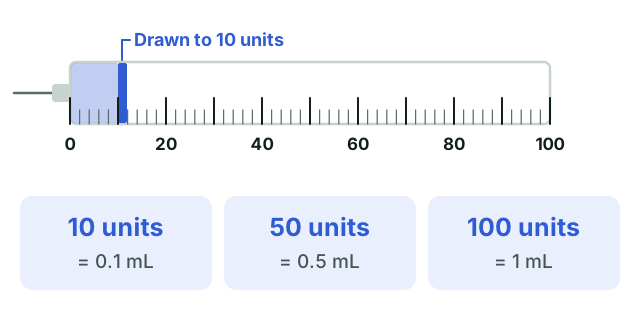
Insulin-syringe units measure volume, not drug. On a U-100 scale, 100 units equals 1 mL, so 1 unit equals 0.01 mL. The concentration decides how much tesamorelin is in each unit.
| Formulation | Concentration (label) | Tesamorelin per unit (U-100) | Label dose | Units |
|---|---|---|---|---|
| Egrifta SV | 4 mg/mL | 0.04 mg (40 mcg) | 1.4 mg | 35 |
| Egrifta WR | 8 mg/mL | 0.08 mg (80 mcg) | 1.28 mg | 16 |
The same 16 units of Egrifta SV would hold only 0.64 mg, and 35 units of Egrifta WR would hold 2.8 mg, more than twice its label dose. That is the practical reason the labels forbid substitution. The kits supply their own syringes; the Egrifta WR instructions refer to “the 16 mark,” which is the same 0.16 mL. The mg/mL to units converter does this arithmetic for any concentration.
Injection sites
Both labels say to inject into the abdomen, rotating to different areas of the abdomen each time, and not into scar tissue, bruises or the navel. Rotation matters here more than for many drugs: injection site reactions occurred in 25% of people on tesamorelin versus 14% on placebo in the first 26 weeks of the trials. The injection sites guide shows abdominal rotation patterns.
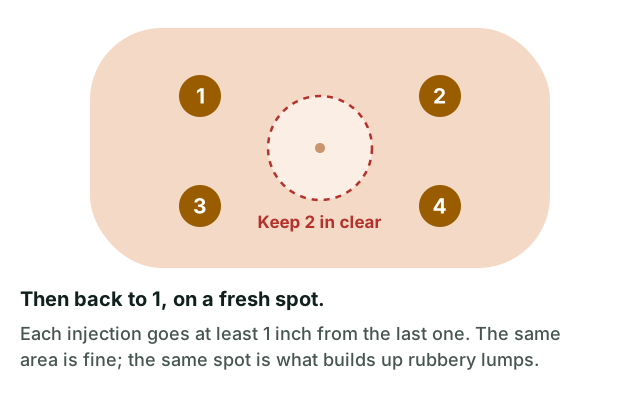
The thigh and arm sites used for some other drugs are not in the tesamorelin labels, which name only the abdomen.
When to inject tesamorelin
The labels do not specify a time of day, only once daily. The bedtime timing you may read about comes from a research trial of a different dose, described below.
What happens at each step
There are no steps. Neither label describes a dose increase, a maintenance step or a taper, so day 1 and week 26 use the same dose.
| Point in treatment | What the label or trials describe |
|---|---|
| Before starting | Glucose status checked; contraindications reviewed, including pituitary problems, active cancer and pregnancy |
| Day 1 onward | The same fixed dose once daily |
| By week 13 | High IGF-1 levels could appear |
| Week 26 | The point at which the trials measured visceral fat |
| After week 26 | The label says to weigh continuing in anyone whose visceral fat has not come down |
| On stopping | No taper is described. In the trials, visceral fat came back after switching to placebo |
The 2026 Ditta meta-analysis found visceral fat reductions were significant only in trials of 26 weeks or longer, which fits that timeline.
What if a dose is missed?
Neither the Egrifta SV nor the Egrifta WR patient information addresses missed doses. Ask your prescriber or pharmacist, or call the number on the label, 1-833-23-THERA. Two things do follow from the labels. The dose is once a day, and neither label describes a double dose. And with Egrifta WR, a skipped day does not stretch the vial: the label still says to discard it 7 days after mixing.
Doses used outside the label
Published trials of tesamorelin for other purposes used doses close to the original label. The liver-fat trials in adults with HIV used 2 mg of the original formulation daily. A 2012 trial of thinking and memory in adults aged 55 to 87 used 1 mg daily, self-injected 30 minutes before bedtime, for 20 weeks. Those were research protocols, not approved regimens, and those milligram figures refer to older product, so they do not transfer to either current product.
Common mistakes
- Swapping products at the same volume. 16 units of WR and 16 units of SV are not the same dose.
- Using the wrong water. Each kit’s diluent is specific, and the labels say to use only the one supplied.
- Keeping leftover Egrifta SV. It is single use and mixed fresh for each dose.
- Using Egrifta WR past day 7. The label says to discard it 7 days after mixing, even with liquid left.
- Refrigerating a mixed vial. Both labels say not to refrigerate or freeze the mixed solution, although Egrifta WR is kept at room temperature for the week.
- Shaking the vial. Roll Egrifta SV and swirl Egrifta WR.
- Treating a research vial as Egrifta. Tesamorelin sold “for research use only” may be shipped only for lab work under 21 CFR 312.160, is not legal to use on people, and none of the numbers above applies to it.
- Sharing a syringe. The label says never to share one, even if the needle is changed.
What to watch for
The label lists who should not use tesamorelin: anyone with a damaged or removed pituitary, active cancer, a known allergy to it, or a pregnancy. While on it, the label asks the prescriber to check IGF-1 and blood glucose periodically, and to consider stopping if IGF-1 stays well above normal or glucose problems develop without a clear benefit. Allergic reactions such as rash, hives or flushing mean stopping and getting prompt medical attention, and swelling of the face or throat, trouble breathing or fainting means emergency care. The full list, with percentages, is in tesamorelin side effects.
Compare
- PeptidesFDA approvedTesamorelinTesamorelin (Egrifta) is FDA-approved only for excess belly fat in adults with HIV.
- PeptidesFDA approvedSide effectsThe most common tesamorelin side effects are injection site reactions (17%) and joint pain (13%).
- LearnHow to reconstituteHow a prescribed freeze-dried vial is mixed with bacteriostatic water, the mg/mL and units math worked through, storage, and mistakes that waste a vial.
Peptide news, sorted. Plus the printable dose chart.
Sorted, every Tuesday: the week's peptide and GLP-1 news in five minutes: FDA moves, new studies explained, and price changes. Subscribe and the one-page dose and injection-site chart arrives first.
Questions people ask
How many units is 1.28 mg of Egrifta WR?
How many units is 1.4 mg of Egrifta SV?
Why is the Egrifta WR dose lower than Egrifta SV?
Can the dose be increased for better results?
What is the best time of day to inject tesamorelin?
What if I miss a dose of tesamorelin?
Sources
Primary sources first: FDA labels and documents, peer-reviewed trials, registries.
- 1Egrifta WR (tesamorelin) for injection, 11.6 mg/vial, prescribing information and Instructions for Use, Theratechnologies, revised 3/2025, via FDAaccessdata.fda.gov
- 2Egrifta SV (tesamorelin) for injection, 2 mg/vial, prescribing information and Instructions for Use, Theratechnologies, revised 2/2024, via FDAaccessdata.fda.gov
- 3DailyMed. Egrifta WR (tesamorelin) kit, SPL version 2, published August 3, 2026dailymed.nlm.nih.gov
- 4DailyMed. Egrifta SV (tesamorelin) kit, SPL version 9, published July 31, 2026dailymed.nlm.nih.gov
- 5Egrifta (tesamorelin for injection), 1 mg/vial, original prescribing information, November 2010, via FDAaccessdata.fda.gov
- 6Theratechnologies. Announces availability of Egrifta WR, September 5, 2025 (via Nasdaq)nasdaq.com
- 7THERA patient support program, manufacturer page for Egrifta WR, checked November 2, 2026egriftawr.com
- 8Ditta AM et al. Efficacy and safety of tesamorelin in people living with HIV with lipodystrophy: a systematic review and meta-analysis. J Int Assoc Provid AIDS Care 2026pmc.ncbi.nlm.nih.gov
- 9Stanley TL et al. Effect of tesamorelin on visceral fat and liver fat in HIV-infected patients with abdominal fat accumulation. JAMA 2014pubmed.ncbi.nlm.nih.gov
- 10Stanley TL et al. Effects of tesamorelin on non-alcoholic fatty liver disease in HIV. Lancet HIV 2019pubmed.ncbi.nlm.nih.gov
- 11Baker LD et al. Effects of growth hormone-releasing hormone on cognitive function in adults with mild cognitive impairment and healthy older adults. Arch Neurol 2012pubmed.ncbi.nlm.nih.gov
- 1221 CFR 312.160, drugs for investigational use in laboratory research animals or in vitro testslaw.cornell.edu
More on Tesamorelin
- OverviewTesamorelinTesamorelin (Egrifta) is FDA-approved only for excess belly fat in adults with HIV. It cut visceral fat 14 to 18% in trials. Benefits, risks and cost.
- Side effectsThe most common tesamorelin side effects are injection site reactions (17%) and joint pain (13%). Label rates, blood sugar risks, and when to call.Read
PeptideSorted Editorial Team
Editorial review
The PeptideSorted editors check every guide against its cited sources before publication: each number against its FDA label, trial or registry, the FDA status against current FDA and HHS documents, and the wording against our describe-never-prescribe rule. Licensed clinicians who join the review panel are listed by name on the editorial team page.
This page was checked against its cited sources by the PeptideSorted editorial team. Licensed clinicians on our review panel are listed on the editorial team page. Every health page cites primary sources and shows its review date. Read the editorial policy and how medical review works, or report an error via corrections. Educational only; not medical advice.