
Short answer
The most common tesamorelin side effects are injection site reactions (17% vs 6% on placebo) and joint pain (13% vs 11%), followed by limb pain, muscle aches and swelling. Many trace to fluid retention. The label also warns about raised IGF-1, higher blood sugar (5% vs 1% reached diabetes-range HbA1c) and allergic reactions (4%). It is contraindicated in pregnancy.
- What it is
- A synthetic analog of growth hormone-releasing factor (GHRH), injected under the skin once a day to raise the body's own growth hormone.
- FDA status
- FDA approved
Approved as Egrifta November 10, 2010 for excess abdominal fat in HIV-infected adults with lipodystrophy. The Egrifta SV and Egrifta WR labels share the same safety data, drawn from trials of the original formulation.
- Evidence level
FDA label
Dosing comes from the FDA-approved prescribing information.
The most common side effects of tesamorelin are injection site reactions, in 17% of people versus 6% on placebo, and joint pain, in 13% versus 11%. The safety numbers for both current products, Egrifta SV and Egrifta WR, come from the same source: the original phase 3 trials, in which 543 adults with HIV received 2 mg of the first Egrifta formulation daily and 263 received placebo for 26 weeks. The Egrifta WR label says its adverse reactions “are expected to be similar” because the newer dose produces similar blood levels. For doses, see tesamorelin dosage.
The label table: first 26 weeks, combined studies
The label lists every reaction that occurred in at least 1% of people and more often on tesamorelin than on placebo.
| Side effect | Placebo (n=263) | Tesamorelin (n=543) |
|---|---|---|
| Injection site reaction (redness, itching, rash, hives, pain, swelling, irritation, bleeding) | 6% | 17% |
| Arthralgia (joint pain) | 11% | 13% |
| Pain in extremity (arms or legs) | 5% | 6% |
| Myalgia (muscle pain) | 2% | 6% |
| Peripheral edema (swelling of hands, feet or ankles) | 2% | 6% |
| Paresthesia (tingling or pins and needles) | 2% | 5% |
| Hypoesthesia (numbness) | 2% | 4% |
| Rash | 2% | 4% |
| Vomiting | 0% | 3% |
| Dyspepsia (indigestion) | 1% | 2% |
| Musculoskeletal pain | 1% | 2% |
| Pain | 1% | 2% |
| Pruritus (itching) | 1% | 2% |
| Musculoskeletal stiffness | 0% | 2% |
| Blood creatine phosphokinase increased (a muscle enzyme) | 0% | 1% |
| Carpal tunnel syndrome | 0% | 1% |
| Joint swelling | 0% | 1% |
| Muscle strain | 0% | 1% |
| Night sweats | 0% | 1% |
| Palpitations | 0% | 1% |
Two patterns stand out. First, injection site reactions are the one category with a large gap over placebo. Second, most of the rest (joint pain, limb pain, muscle aches, swelling, tingling, numbness, carpal tunnel) belong to one family the label calls fluid retention, which it links to the rise in growth hormone. Joint pain is common even on placebo in this population, so the difference is 2 percentage points.
When side effects start and fade
The labels give only part of the timeline, so here is what they do say.
| Effect | When | What the label says about fading |
|---|---|---|
| Injection site reactions | Around each injection, within the first 26 weeks in the trial counts | Rotating sites reduces them; no duration given |
| Fluid retention (swelling, joint pain, carpal tunnel) | During treatment; no onset given | Either transient or resolves after stopping |
| High IGF-1 | As early as week 13 | At 52 weeks, fewer people were above 2 SDS (34% vs 47% at 26 weeks) among those who stayed on it |
| Raised HbA1c | Counted from baseline to week 26 | Glucose is monitored; stopping is considered without a clear benefit |
| Allergic reactions | No onset given | Stop treatment and seek prompt care |
How often people stopped
The current labels do not restate discontinuation rates. The original 2010 Egrifta label does. During the first 26 weeks, 9.6% of people on tesamorelin and 6.8% on placebo stopped because of an adverse reaction. Apart from people with allergic reactions who were withdrawn under the trial protocol (2.2%), the most common reasons were growth hormone-related effects (4.2%) and injection site reactions (4.6%). In the following 26 weeks, 2.4% of those who stayed on tesamorelin stopped for adverse events, versus 5.2% of those switched to placebo. The NEJM report of the first trial likewise found that adverse events overall did not differ significantly between groups, but more people on tesamorelin withdrew because of one.
What helps
- Rotate injection sites. This is the label’s own advice for injection site reactions. Stay in the abdomen and avoid scar tissue, bruises and the navel.
- Check the solution. The label says not to use a solution that is cloudy, colored or has solid particles.
- Use a new syringe for each injection and never share one, even if the needle is changed.
- Keep your monitoring appointments. IGF-1 and glucose are the two label tests.
- Tell your prescriber early about swelling or hand numbness, since the label says fluid effects are transient or resolve after stopping.
- If you have diabetes, ask about your medicines. The label says anti-diabetic drugs may need adjusting.
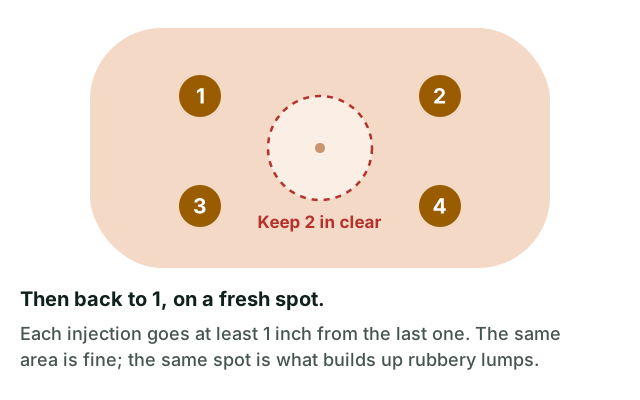
We did not find label or clinical-source guidance on other remedies, such as ice or pain relievers, so ask your pharmacist. The injection sites guide has more on technique.
The warnings
The Egrifta SV and Egrifta WR labels list the same warnings in Section 5.
- Raised IGF-1. Tesamorelin raises IGF-1 (insulin-like growth factor 1), and the label says the effects of prolonged high IGF-1 “are unknown.” At 26 weeks, 47% of people had IGF-1 more than 2 standard deviation scores (SDS) above normal and 36% more than 3 SDS, seen as early as week 13. Among those who stayed on it to 52 weeks, 34% were above 2 SDS and 23% above 3 SDS. The label asks for IGF-1 monitoring and suggests considering stopping with persistent levels above about 3 SDS, especially if the response is not strong.
- Glucose intolerance or diabetes. HbA1c reached 6.5% or higher in 5% on tesamorelin versus 1% on placebo by week 26 (hazard ratio 3.3, 95% CI 1.4 to 9.6). Glucose should be checked before starting and periodically after. People with diabetes should also be watched for new or worsening retinopathy (diabetic eye disease).
- Fluid retention. Swelling, joint pain and carpal tunnel syndrome, which the label says are either transient or resolve after stopping.
- Hypersensitivity (allergic) reactions. Occurred in 4% of people in the trials: itching, redness, flushing, hives and rash. The label says to seek prompt medical attention and stop immediately if one is suspected.
- Injection site reactions. 25% on tesamorelin versus 14% on placebo over the first 26 weeks, using a broader count than the table. Rotating sites around the abdomen is the label’s advice.
- Cancer risk. Growth hormone is a growth factor. Tesamorelin is contraindicated with active cancer, and the label says to stop it if a cancer recurs. For people with a treated, stable cancer it calls for careful evaluation of the risk of reactivation. It also notes the higher background cancer risk in people with HIV.
- Critical illness. High doses of growth hormone have been linked to increased deaths in people with acute critical illness after heart or abdominal surgery, major trauma or respiratory failure. The label says to consider stopping tesamorelin in critically ill patients. The manufacturer’s safety information tells people to mention scheduled heart or stomach surgery, or breathing problems, before using it.
Two 2026 meta-analyses of the HIV trials reported no significant average change in fasting glucose, and one found no significant difference in serious adverse events (risk ratio 1.07). Those findings do not cancel the label warning. An average can stay flat while some individuals cross a diabetes threshold, which is what the 5% versus 1% figure counts, and the trials excluded people with medication-treated diabetes.
Antibodies
The label reports anti-tesamorelin antibodies in 50% of people at 26 weeks and 47% at 52 weeks, and in 85% of those who had an allergic reaction. About 60% of people with antibodies also had antibodies that cross-reacted with the body’s own GHRH. Neutralizing antibodies were found in the lab in 10% (against tesamorelin) and 5% (against natural GHRH) at week 52. Visceral fat and IGF-1 responses were similar with or without antibodies.
Who should not use it
The label’s contraindications are a damaged or removed pituitary (from surgery, hypopituitarism, a pituitary tumor, head radiation or head trauma), active cancer, known allergy to tesamorelin or its ingredients, and pregnancy. In pregnancy, rat studies showed hydrocephaly in offspring at about two and four times human exposure, and anyone who becomes pregnant is told to stop.
The label also tells people with HIV not to breastfeed, says safety in children has not been established and that it is not for children, and notes there is no information in people over 65. Two drug interactions are flagged: drugs cleared by liver CYP450 enzymes (such as corticosteroids, sex steroids, anticonvulsants and cyclosporine) should be monitored, and people on glucocorticoid replacement for adrenal insufficiency may need higher doses. Its effects in kidney or liver impairment have not been established.
Outside the label population
All of the numbers above come from adults with HIV. A 2012 randomized trial of thinking and memory in older adults without HIV, using 1 mg daily for 20 weeks, reported mild adverse events in 68% on tesamorelin versus 36% on placebo, and a 35% rise in fasting insulin, still within the normal range, in the group with mild cognitive impairment. No label covers use outside HIV lipodystrophy.
Vials sold online “for research use only” are outside all of this data. Under 21 CFR 312.160 they may be shipped only for lab work, they are not legal to use on people, and nothing here tells you what they contain.
Red flags: stop and get emergency help
The Egrifta patient information says to stop using it and get emergency medical help right away for signs of a serious allergic reaction:
- Rash or hives anywhere over the body
- Swelling of the face or throat
- Shortness of breath or trouble breathing
- Fast heartbeat
- Feeling faint or fainting
- Itching with reddening or flushing of the skin
When to call the prescriber
The label and its patient information point to these:
- Swelling, more joint pain, or pain or numbness in the hands or wrists.
- Signs of high blood sugar, especially with existing diabetes or prediabetes.
- Any return of cancer symptoms in someone with a past cancer (stop and call).
- A new pregnancy (stop and call).
- An injection site that stays red, painful or swollen. The patient information says injection site reactions may sometimes be serious.
- A planned heart or stomach operation, or a new serious illness.
Side effects can be reported to FDA at 1-800-FDA-1088 or to the manufacturer at 1-833-238-4372.
Compare
- PeptidesFDA approvedTesamorelinTesamorelin (Egrifta) is FDA-approved only for excess belly fat in adults with HIV.
- PeptidesFDA approvedDosageThe label dose of tesamorelin is 1.4 mg (0.35 mL) of Egrifta SV or 1.28 mg (0.16 mL) of Egrifta WR once daily.
- PeptidesCompounded (Rx)Side effectsThe most common sermorelin side effect is an injection site reaction, in about 1 in 6 patients.
Peptide news, sorted. Plus the printable dose chart.
Sorted, every Tuesday: the week's peptide and GLP-1 news in five minutes: FDA moves, new studies explained, and price changes. Subscribe and the one-page dose and injection-site chart arrives first.
Questions people ask
Does tesamorelin cause diabetes?
Why does tesamorelin cause joint pain and swelling?
How common are injection site reactions?
Is tesamorelin safe in pregnancy?
Does tesamorelin cause cancer?
Do people develop antibodies to tesamorelin?
Sources
Primary sources first: FDA labels and documents, peer-reviewed trials, registries.
- 1Egrifta WR (tesamorelin) for injection, 11.6 mg/vial, prescribing information (Sections 4, 5, 6.1, 8.1, 12.6), Theratechnologies, revised 3/2025, via FDAaccessdata.fda.gov
- 2Egrifta SV (tesamorelin) for injection, 2 mg/vial, prescribing information, Theratechnologies, revised 2/2024, via FDAaccessdata.fda.gov
- 3DailyMed. Egrifta WR (tesamorelin) kit, SPL version 2, published August 3, 2026dailymed.nlm.nih.gov
- 4DailyMed. Egrifta SV (tesamorelin) kit, SPL version 9, published July 31, 2026dailymed.nlm.nih.gov
- 5Egrifta WR important safety information, manufacturer page, checked November 2, 2026egriftawr.com
- 6Egrifta (tesamorelin for injection), original prescribing information, November 2010 (Section 6, discontinuation rates), via FDAaccessdata.fda.gov
- 7Falutz J et al. Metabolic effects of a growth hormone-releasing factor in patients with HIV. N Engl J Med 2007pubmed.ncbi.nlm.nih.gov
- 8Falutz J et al. Effects of tesamorelin: a pooled analysis of two phase 3 trials with safety extension data. J Clin Endocrinol Metab 2010pubmed.ncbi.nlm.nih.gov
- 9Baker LD et al. Effects of growth hormone-releasing hormone on cognitive function in adults with mild cognitive impairment and healthy older adults. Arch Neurol 2012pubmed.ncbi.nlm.nih.gov
- 10Ditta AM et al. Efficacy and safety of tesamorelin in people living with HIV with lipodystrophy: a systematic review and meta-analysis. J Int Assoc Provid AIDS Care 2026pmc.ncbi.nlm.nih.gov
- 11Badran AS et al. Body composition, hepatic fat, metabolic, and safety outcomes of tesamorelin in HIV-associated lipodystrophy: a meta-analysis of randomized controlled trials. Obes Res Clin Pract 2026pubmed.ncbi.nlm.nih.gov
- 1221 CFR 312.160, drugs for investigational use in laboratory research animals or in vitro testslaw.cornell.edu
More on Tesamorelin
- OverviewTesamorelinTesamorelin (Egrifta) is FDA-approved only for excess belly fat in adults with HIV. It cut visceral fat 14 to 18% in trials. Benefits, risks and cost.
- DosageThe label dose of tesamorelin is 1.4 mg (0.35 mL) of Egrifta SV or 1.28 mg (0.16 mL) of Egrifta WR once daily. Mixing, units, timing and missed doses.Read
PeptideSorted Editorial Team
Editorial review
The PeptideSorted editors check every guide against its cited sources before publication: each number against its FDA label, trial or registry, the FDA status against current FDA and HHS documents, and the wording against our describe-never-prescribe rule. Licensed clinicians who join the review panel are listed by name on the editorial team page.
This page was checked against its cited sources by the PeptideSorted editorial team. Licensed clinicians on our review panel are listed on the editorial team page. Every health page cites primary sources and shows its review date. Read the editorial policy and how medical review works, or report an error via corrections. Educational only; not medical advice.