
Short answer
There is no evidence-based best peptide serum, because no published trial compares finished products. Judge any serum by its label: named peptides, a stated percentage, a formula for your skin type, and claims a cosmetic can honestly make. Test it on a small patch for 7 to 10 days and give it 6 weeks to 3 months.
- What it is
- A practical checklist for evaluating any cosmetic peptide serum without relying on brand names or rankings.
- FDA status
- Not a drug
Peptide serums are cosmetics. They do not need FDA approval before sale and are not reviewed for effectiveness; the company is responsible for safety.
- Evidence level
n/a
There is no evidence-based “best” peptide serum. No published trial compares finished products against each other, and most studies test an ingredient, so any “top 10” list is opinion or advertising. What you can judge is what the label shows and what the marketing claims, and the checklist here works on any bottle, with no product names and no rankings. Peptide serums are cosmetics: FDA does not approve them before sale or review whether they work, and the company is legally responsible for their safety. For what the peptides do, see the skincare peptides index or the peptide serum guide.
The checklist
| Check | What to look for | Why it matters |
|---|---|---|
| Named peptides | Specific INCI names in the ingredient list, such as palmitoyl pentapeptide-4, acetyl hexapeptide-8 or copper tripeptide-1 | Front-of-pack blend names are trademarks; the ingredient list shows what is actually present |
| Concentration | A stated percentage of the peptide itself | Not legally required; peptides are used at tiny amounts, so position on the list says little |
| Evidence for those peptides | Whether the peptide has any published controlled study | Many cosmetic peptides have one small study or none published |
| Skin type | “Sensitive skin,” “non-comedogenic,” “hypoallergenic” if those apply to you | AAD advice: choose products made for your skin type |
| One new product at a time | Add a single new active, not a routine of several | AAD: several anti-aging products at once can irritate skin |
| A way to reach the company | A consumer contact or hotline | AAD lists this among label features to look for |
| Claims | Appearance-based claims, not medical ones | Treatment or “regenerate cells” claims make it an unapproved drug |
AAD is the American Academy of Dermatology, whose public advice runs through this guide.
Which peptide should you look for?
Choose by goal, and know how thin the evidence is before you pay for it. This table compares ingredients, not bottles.
| Your goal | Name to find on the label | What the best study showed | Weak spot |
|---|---|---|---|
| Fine lines | Palmitoyl pentapeptide-4 | 93 women, 12 weeks, split-face: fewer lines than the same moisturizer without it | Company-run; measured appearance |
| Expression lines | Acetyl hexapeptide-8 | 60 adults, 4 weeks: 48.9% judged improved vs 0% on placebo | An independent 19-woman study found no difference |
| Expression lines, longer relative | Acetyl octapeptide-3 (SNAP-8) | No published study of the peptide alone | See the SNAP-8 evidence |
| A copper peptide | Copper tripeptide-1 | A 2026 review found 2 randomized trials among 20 eligible studies | Most cited results were conference abstracts |
| Dark spots | Soy or rice peptides | Very few or no human studies | Relevance “still unclear” |
If a serum lists none of these and only a trademarked blend, you have no way to connect it to any study. Finding the name is the first step, and it still tells you only that the ingredient is present.
Reading the ingredient list
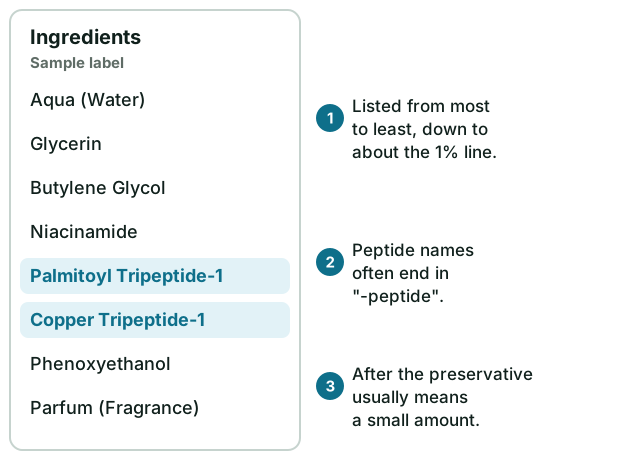
US rules require cosmetic ingredients to be listed in descending order of amount. Ingredients at 1% or less may be listed in any order after those above 1%. Peptides almost always fall in that low group:
- A 93-woman trial of palmitoyl pentapeptide-4 used 3 parts per million, which is 0.0003%.
- The Cosmetic Ingredient Review panel found acetyl hexapeptide-8 safe as used “at concentrations up to 0.005%.”
- One supplier sells its octapeptide as a solution containing 0.05% peptide and suggests using 3% to 10% of the solution, which is about 0.0015% to 0.005% of peptide in the product.
So a peptide listed near the end is normal and tells you nothing about strength. The sample below shows where peptides tend to sit and how to pick them out.
What does a percentage on the bottle mean?
Ask whether the number refers to the peptide or to a supplier’s peptide solution. “10%” of a solution that is itself 0.05% peptide is 0.005% peptide. A bottle advertising a large percentage may hold no more peptide than one that states none. No study has set a minimum effective percentage for a finished serum, and for acetyl hexapeptide-8 the safety panel found too little data to call it safe above 0.005%, so a bigger number is not automatically better.
The copper peptide serum guide covers copper tripeptide-1 specifically, where studies used roughly 0.05% to 2%.
Questions to ask about any study a brand cites
A brand that cites a study has given you something you can check. Five questions separate real evidence from decoration.
- Was it the product or the ingredient? An ingredient result does not automatically apply to a finished serum.
- How many people, and for how long? Many cosmetic peptide studies are small. Some rest on a single study.
- Was there a control? Look for the same formula without the peptide, as in a split-face trial. A before-and-after study cannot separate the peptide from moisturizer or from expectation.
- Was the peptide the only active? A 2017 review warned that in mixtures the results “cannot be claimed clearly to be the effect of the used peptide.”
- Who paid, and is it published? Company funding does not make a result false, but independent work has sometimes failed to repeat it. The same review said peptide studies “are not frequently published in scientific journals.”
Packaging and storage
Published stability data for peptides are mostly laboratory tests of the raw ingredient, not of finished serums on a shelf. For GHK-Cu, oxidizing conditions were the harshest stress in lab testing, while solutions at skin-like pH were stable for two weeks at 60 °C. We found no published study comparing packaging types, such as airless pumps against droppers, for peptide serums. Follow the storage directions on the pack, and treat packaging claims as marketing unless the brand shows test data.
Patch testing and irritation
Published peptide studies report few side effects; a 2026 meta-analysis reported no severe adverse events across its trials. But a reaction can come from any ingredient, including preservatives and fragrance. The AAD’s test:
- Apply the serum to a quarter-sized spot where it will not be rubbed or washed off, such as the underside of the arm or the bend of the elbow.
- Use the normal amount, twice a day, for 7 to 10 days.
- If the skin turns red, itchy or swollen, wash it off gently and do not use it again.
- Stop any anti-aging product that stings, burns or tingles, unless a dermatologist prescribed it and says that is expected.
A severe reaction that does not improve is a reason to see a dermatologist.
How long to give it
The AAD says most anti-aging products take at least six weeks to work, and sometimes up to three months. A moisturizer can plump fine lines within a few days, so a quick change may be hydration rather than the peptide. Results last only while the product is used.
A simple way to judge is to photograph your skin in the same light before you start and again at three months. Add one new product during that time, or you will not know which one made the difference.
Claims that are red flags
| Claim | Why to be skeptical |
|---|---|
| “Look 10 years younger overnight,” “reduces all signs of aging” | The AAD calls promises like these “too good to be true” and says anti-aging products “deliver modest results.” |
| “Clinically proven” | The AAD says this means the product was given to consumers to try, not that it went through clinical trials or FDA approval. The FTC requires health claims to be backed by “competent and reliable scientific evidence.” |
| “FDA-approved” on a cosmetic | Cosmetics do not need FDA premarket approval (color additives aside), so this is misleading. |
| “Botox in a bottle,” “needle-free injection results” | In an FDA laboratory study of a popular “Botox-like” peptide, none reached the dermis. Topical peptides are not equivalent to injections. |
| “Regenerates cells,” “heals,” “restores hair growth” | FDA’s own examples of claims that make a product a drug. A cosmetic making them is being sold as an unapproved drug. |
| Dramatic before-and-after photos and testimonials | The FTC says testimonials reporting results “more dramatic than users can generally expect are likely to be deceptive,” and “results not typical” disclaimers do not fix that. |
| Price as proof | The AAD says effective anti-aging products come in all price ranges. |
| A long list of trademarked peptide blends, no percentages | Mixtures make it impossible to know what any one peptide contributes, a limitation a 2017 review flagged across peptide studies. |
| Vials or powders labeled “research use only” | These are not cosmetics, and they are not legal to use on people. |
Is a peptide serum worth adding?
It depends on what else is in your routine, because a serum is the last thing to add. The AAD calls sunscreen and moisturizer the two most effective anti-aging products and suggests starting there. In a randomized trial of 903 adults followed for 4.5 years, daily broad-spectrum sunscreen users showed no detectable increase in skin aging and 24% less aging than occasional users. A peptide serum can be added to that routine, and it does not replace it. The peptides for skin guide sets out how serums compare with sunscreen, tretinoin and other options.
What the law does and does not guarantee
Under the Modernization of Cosmetics Regulation Act of 2022, companies must register manufacturing facilities with FDA, list their products and ingredients, keep records supporting the product’s safety, and report serious adverse events to FDA within 15 business days. On October 29, 2026, FDA also issued final guidance on mandatory cosmetic recalls. None of that involves proving the product works. FDA still does not approve cosmetics before sale. A serum that is legal to sell has not been shown by anyone to deliver what its box promises.
Compare
Peptide news, sorted. Plus the printable dose chart.
Sorted, every Tuesday: the week's peptide and GLP-1 news in five minutes: FDA moves, new studies explained, and price changes. Subscribe and the one-page dose and injection-site chart arrives first.
Questions people ask
What is the best peptide serum?
What percentage of peptide should a serum have?
Does a more expensive peptide serum work better?
What does clinically proven mean on a serum?
How long should I use a peptide serum before judging it?
How do I patch test a new serum?
Sources
Primary sources first: FDA labels and documents, peer-reviewed trials, registries.
- 1FDA. FDA authority over cosmetics: how cosmetics are not FDA-approved, but are FDA-regulated (content current as of November 18, 2025)fda.gov
- 2FDA. Modernization of Cosmetics Regulation Act of 2022 (MoCRA) (content current as of October 29, 2026)fda.gov
- 3FDA. Is it a cosmetic, a drug, or both? (or is it soap?) (content current as of September 11, 2024)fda.gov
- 421 CFR 701.3, designation of ingredients on cosmetic labelslaw.cornell.edu
- 521 CFR 312.160, drugs for investigational use in laboratory research animals or in vitro testslaw.cornell.edu
- 6FTC. Health products compliance guidanceftc.gov
- 7American Academy of Dermatology. How to select anti-aging skin care productsaad.org
- 8American Academy of Dermatology. How to maximize results from anti-aging skin care productsaad.org
- 9American Academy of Dermatology. How to test skin care products (last updated August 10, 2021)aad.org
- 10Schagen SK. Topical peptide treatments with effective anti-aging results. Cosmetics 2017mdpi.com
- 11Nukaly HY et al. Oral and topical peptides for skin aging: systematic review and meta-analysis of randomized controlled trials. Front Med 2026pubmed.ncbi.nlm.nih.gov
- 12Robinson LR et al. Topical palmitoyl pentapeptide provides improvement in photoaged human facial skin. Int J Cosmet Sci 2005pubmed.ncbi.nlm.nih.gov
- 13Wang Y et al. The anti-wrinkle efficacy of argireline, a synthetic hexapeptide, in Chinese subjects: a randomized, placebo-controlled study. Am J Clin Dermatol 2013pubmed.ncbi.nlm.nih.gov
- 14Henseler H. Investigating the effects of Argireline in a skin serum containing hyaluronic acids on skin surface wrinkles. GMS Interdiscip Plast Reconstr Surg DGPW 2023pubmed.ncbi.nlm.nih.gov
- 15Mokhtar J et al. The regenerative potential of GHK-Cu in aesthetic medicine (systematic review). Aesthet Surg J 2026pubmed.ncbi.nlm.nih.gov
- 16Johnson W Jr et al. Safety assessment of acetyl hexapeptide-8 amide as used in cosmetics (Cosmetic Ingredient Review). Int J Toxicol 2025pubmed.ncbi.nlm.nih.gov
- 17Kraeling ME et al. In vitro skin penetration of acetyl hexapeptide-8 from a cosmetic formulation (FDA laboratory study). Cutan Ocul Toxicol 2015pubmed.ncbi.nlm.nih.gov
- 18Ingredient supplier listing for SNAP-8 peptide solution: INCI composition, peptide content and use level (Knowde)knowde.com
- 19Mortazavi SM et al. Topically applied GHK as an anti-wrinkle peptide: advantages, problems and prospective. BioImpacts 2024pubmed.ncbi.nlm.nih.gov
- 20Hughes MC et al. Sunscreen and prevention of skin aging: a randomized trial. Ann Intern Med 2013pubmed.ncbi.nlm.nih.gov
More in Skincare
- Copper peptide serumCopper peptide serum contains GHK-Cu, listed as copper tripeptide-1. See what studies found, the strengths tested, what is known on mixing, and its limits.Read
- Peptide serumPeptide serums are cosmetics backed by small, often company-run studies. What each type does, how to read the label, and what has stronger evidence.Read
- SNAP-8SNAP-8 is a trade name for acetyl octapeptide-3. No published study tests it alone, and its wrinkle figure comes from the supplier. See the evidence.Read
PeptideSorted Editorial Team
Editorial review
The PeptideSorted editors check every guide against its cited sources before publication: each number against its FDA label, trial or registry, the FDA status against current FDA and HHS documents, and the wording against our describe-never-prescribe rule. Licensed clinicians who join the review panel are listed by name on the editorial team page.
This page was checked against its cited sources by the PeptideSorted editorial team. Licensed clinicians on our review panel are listed on the editorial team page. Every health page cites primary sources and shows its review date. Read the editorial policy and how medical review works, or report an error via corrections. Educational only; not medical advice.