
Short answer
Topical GHK-Cu may improve the look of skin, but the proof is weak. It has been tested in a handful of small human studies, most lasting 8 to 16 weeks, with mixed results and several seen only as abstracts. On a label it is copper tripeptide-1. As a cosmetic it needs no FDA approval; injectable GHK-Cu is an unapproved product.
- What it is
- A naturally occurring tripeptide (glycine, histidine, lysine) bound to a copper ion, used in skin-care products as copper tripeptide-1.
- FDA status
- Not FDA approved
Not approved as a drug. Cosmetic creams and serums need no approval if they make no drug claims. Non-injectable GHK-Cu is in 503A category 1 (under evaluation) on the May 14, 2026 list; injectable GHK-Cu has no compounding route. GHK-Cu is not in the October 2026 HHS peptide policy.
- Evidence level
Early human studies
Small or uncontrolled human studies only.
Topical GHK-Cu might improve how skin looks, and the proof is weak. A cream or serum is the legal, cosmetic form of a peptide that is otherwise sold as an unapproved injectable, and this is a different regulatory case from the vial: a serum sold to improve appearance needs no FDA approval as long as it makes no drug claims. FDA has not approved GHK-Cu as a drug for any use. Vials sold for research use only are not legal to use on people, and none of the studies below tested one.
What the topical studies tested
| Study | Who and how many | Product and concentration | Length | Measured | Result |
|---|---|---|---|---|---|
| Bishop et al. 1992, J Vasc Surg | 86 evaluable patients with venous leg ulcers; randomized, evaluator-blinded | 0.4% tripeptide copper cream vs 1% silver sulfadiazine cream vs placebo | Not stated in abstract | Ulcer size | Copper cream no better than placebo |
| Mulder et al. 1994, Wound Repair Regen | People with diabetic foot ulcers; multicenter, randomized, evaluator-blinded, vehicle-controlled | GHK-Cu gel with standard wound care; concentration not stated in abstract | Not stated in abstract | Ulcer closure, infection | Median closure 98.5% vs 60.8% with vehicle; infection 7% vs 34% |
| Abdulghani et al., conference abstract (as summarized in 2018 and 2024 reviews) | 20 people; each applied two creams to the thighs | GHK-Cu cream vs melatonin, vitamin C and tretinoin creams | 1 month in one review, 12 weeks in another | Procollagen in skin biopsies | Increase in 70% with GHK-Cu, 50% with vitamin C, 40% with retinoic acid |
| Leyden 2002, conference abstract | 71 women with mild to advanced photodamage | GHK-Cu facial cream; concentration not reported | 12 weeks | Skin density, thickness, laxity, fine lines | Reported improvement |
| Leyden 2002, conference abstract | 41 women with photodamage around the eyes | GHK-Cu eye cream vs placebo and vitamin K cream | 12 weeks | Lines, wrinkles, skin density | Reported better than both comparators |
| Miller et al. 2006, Arch Facial Plast Surg | 13 patients after CO2 laser resurfacing around the mouth; randomized | Post-laser skin-care regimen with or without GHK-Cu products | 12 weeks | Redness (computer and blinded raters), wrinkles, questionnaire | No objective difference; patients using GHK-Cu more satisfied (P = .04) |
| Badenhorst et al. 2016 (as summarized in 2018 and 2026 reviews) | Small group of female volunteers; randomized, double-blind | GHK-Cu in a nano-lipid carrier vs carrier alone vs a commercial peptide comparator, twice daily | 8 weeks | Wrinkle volume and depth | Wrinkle volume 55.8% lower and depth 32.8% lower than carrier alone |
| Split-face acne-scar study 2025 (as summarized in a 2026 review) | People with acne scars | Microneedling plus 0.5% to 1% GHK-Cu serum vs microneedling alone | 16 weeks | Acne scar score | Early benefit, no difference by week 16; hyperpigmentation flagged |
| Bo et al. 2026 (as summarized in a 2026 review) | 18 participants; split-face | Nominal 2% GHK-Cu serum | 12 weeks | Eyebrow hair count and diameter | Improved, no serious adverse effects; the product’s copper form and local exposure were not defined |
How to read this table
- Small and short. A 2026 systematic review says most human GHK-Cu studies enrolled fewer than 100 people and ran 8 to 16 weeks. Another 2026 review in Aesthetic Surgery Journal found 20 eligible studies, of which only 2 were randomized controlled trials.
- Abstracts, not papers. The Leyden facial and eye-cream studies and the Abdulghani biopsy study, which supply most cosmetic marketing claims, were published only as conference abstracts. They have never been peer reviewed in full, and reviews cannot even agree on how long one of them ran.
- Hard outcomes are mixed. Of the two wound trials, one was negative and one positive. The only randomized cosmetic trial with blinded measurement, after laser resurfacing, found no objective difference.
- Who wrote it. The same 2026 review found that about 35% of the primary GHK-Cu literature it covered included the researcher who first isolated the peptide or a colleague, both affiliated with a company that sells copper peptide products.
- Product chemistry. A 2026 review in Pharmaceutics points out that most papers treat GHK-Cu as one fixed ingredient, when its form can change with the formula. Two products with the same label name may not deliver the same thing.
Does topical GHK-Cu get through the skin?
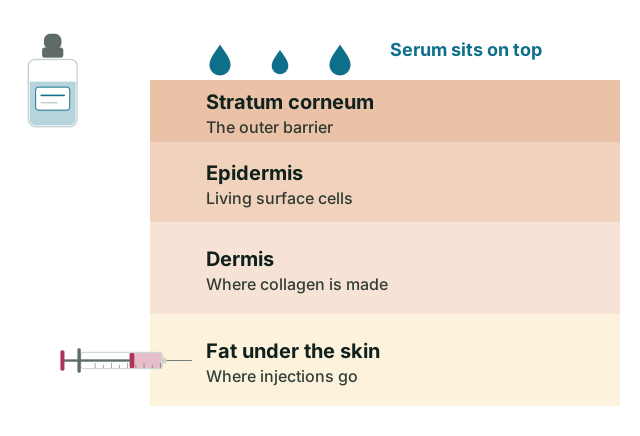
Not easily. GHK-Cu is water-loving and charged, and lab studies show poor passage through intact skin. In one, no peptide crossed untreated human skin in nine hours, while microneedle-treated skin let 134 nanomoles of peptide through. A serum works, if it works, in the outer layers, and that is also why its results say nothing about an injection.
For the bigger picture on skin peptides see peptides for skin, and for percentages and arithmetic see the GHK-Cu dosage page.
How long does topical GHK-Cu take to work?
Nobody has measured the time to a visible result. The studies above checked skin at set points, usually at 8 to 16 weeks, so a reasonable test of any serum takes months. If you start a serum in March, a fair check is around June, and photos in the same light will tell you more than memory. One caution from the acne-scar study: an early gain had disappeared by week 16.
How to read a serum label
| What the label says | What it means |
|---|---|
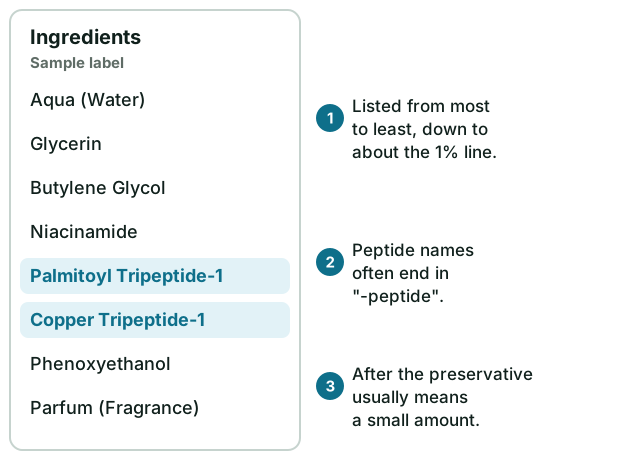
| Copper tripeptide-1 | GHK-Cu. This is its INCI name, the standard ingredient name on cosmetics. |
| Tripeptide-1 | GHK without copper. |
| Palmitoyl tripeptide-1 | GHK with a fatty acid attached and no copper. A different ingredient, with no published clinical studies of its own on wrinkles according to a 2024 review. |
| “Copper peptides” in the product name | A marketing phrase. Check the ingredient list for copper tripeptide-1. |
Position on the list. US rules require cosmetic ingredients in descending order of amount, but anything at 1% or less may be listed in any order after the ingredients above 1%. Published GHK-Cu studies used roughly 0.05% to 2%, so where copper tripeptide-1 sits near the end of a list says little about how much is there. Most labels do not state a percentage.
Claims on the box. FDA treats a product as a drug if it claims to treat disease or change the body’s structure or function. Its examples include claims to “regenerate cells” or “restore hair growth.” A cosmetic making such claims is being sold as an unapproved drug, whatever the ingredient.
Our walkthrough of copper peptide serums covers shopping for one in more detail.
Irritation and side effects
What is known is limited:
- A 2024 review stated that “no studies have been published on the possible side effects” of GHK-Cu or its palmitoyl form.
- A 2025 acne-scar study pairing microneedling with GHK-Cu serum flagged a risk of hyperpigmentation (skin darkening) in the GHK-Cu side, according to a 2026 review.
- A 2015 laboratory study found no clinically significant skin irritation in cell and pig skin models with microneedle delivery, according to a 2026 review.
- Copper is a recognized contact sensitizer in susceptible people, according to a 2026 review, and a penetration-enhancing product or broken skin raises exposure. Someone with a known copper or metal allergy has a reason for extra caution. A trial of GHK-Cu gel excludes people with a known copper or peptide sensitivity.
- Wilson disease is an inherited condition in which copper builds up in the body. No study has tested GHK-Cu in this group, so anyone with it should ask their specialist first.
Microneedling, dermarollers and other devices change the picture, because they open channels through the skin barrier that lab studies show GHK-Cu otherwise struggles to cross. That raises exposure, and no published human trial has tested GHK-Cu delivered by microneedle arrays.
A burning feeling that does not settle, spreading redness, swelling or a rash is a reason to stop and show the ingredient list to a pharmacist or dermatologist. Trouble breathing or swelling of the face or throat after any product is an emergency.
Combining with other actives
The sourced information is thin:
- Hyaluronic acid. In a lab study, GHK-Cu combined with low-molecular-weight hyaluronic acid at a 1 to 9 ratio raised collagen IV production in skin cells and in skin samples. This was not a clinical trial.
- Microneedling. Small studies have paired GHK-Cu serum with dermarollers for acne scars, with mixed results, as in the table above.
- Oxidizing conditions. In stability tests, an oxidizing solution (0.5% hydrogen peroxide) was the harshest stress: only 84.2% of GHK-Cu remained after one hour. Solutions at pH 5.5 and 7.4 showed no detectable breakdown at 60 °C over 14 days.
- Vitamin C, retinoids and acids. One early study compared GHK-Cu with vitamin C and tretinoin creams in separate groups of people, but we found no published study testing them combined, for benefit or for safety. A 2026 review notes that reducing agents and antioxidants shift copper’s chemical state and that chelators such as citrate compete with GHK for copper, so a formula can change what the copper is doing. Whether that matters on skin has not been tested.
The line between cosmetic and drug
Topical GHK-Cu sold to improve appearance is a cosmetic. That does not put it outside regulation: under the 2022 cosmetics law, the company must keep records supporting the product’s safety, report serious adverse events to FDA within 15 business days and register its manufacturing facilities, and FDA can order a recall in serious cases. FDA does not check that a serum works before it goes on sale.
Non-injectable GHK-Cu is also in 503A category 1 on FDA’s May 14, 2026 list, so a pharmacy may compound a prescription cream under FDA’s interim policy. Injectable GHK-Cu is not approved, has no compounding route, and has never been tested in a human trial. GHK-Cu is not on the list in the October 2026 HHS peptide policy, so as of November 2, 2026 its status is unchanged. The topical studies say nothing about injection, and the FDA status tracker shows where each form stands.
Compare
- PeptidesNot FDA approvedGHK-CuGHK-Cu is a copper peptide with small skin studies behind it.
- PeptidesNot FDA approvedDosagePublished GHK-Cu studies used creams and serums from about 0.05% to 2%.
- LearnFDA status trackerWhich peptides are FDA-approved, which HHS tolerates under conditions, and which are not legal to use.
Peptide news, sorted. Plus the printable dose chart.
Sorted, every Tuesday: the week's peptide and GLP-1 news in five minutes: FDA moves, new studies explained, and price changes. Subscribe and the one-page dose and injection-site chart arrives first.
Questions people ask
Does topical GHK-Cu actually reduce wrinkles?
What is copper tripeptide-1 on an ingredient list?
How long does topical GHK-Cu take to work?
Can GHK-Cu irritate skin?
Can I use GHK-Cu with vitamin C or retinol?
Does GHK-Cu help with acne?
Sources
Primary sources first: FDA labels and documents, peer-reviewed trials, registries.
- 1Mokhtar J et al. The regenerative potential of GHK-Cu in aesthetic medicine (systematic review). Aesthet Surg J 2026pubmed.ncbi.nlm.nih.gov
- 2Najafi N et al. A systematic review of the mechanisms and therapeutic applications of GHK-Cu in topical microneedle delivery. Arch Intern Med Res 2026pubmed.ncbi.nlm.nih.gov
- 3Mateescu DM et al. GHK-Cu as a bioactive metallopeptide and drug-delivery cargo: a systematic evidence-mapping review. Pharmaceutics 2026pmc.ncbi.nlm.nih.gov
- 4Mortazavi SM et al. Topically applied GHK as an anti-wrinkle peptide: advantages, problems and prospective. BioImpacts 2024pubmed.ncbi.nlm.nih.gov
- 5Pickart L, Margolina A. Regenerative and protective actions of the GHK-Cu peptide in the light of the new gene data. Int J Mol Sci 2018pubmed.ncbi.nlm.nih.gov
- 6Bishop JB et al. A prospective randomized evaluator-blinded trial of two potential wound healing agents for the treatment of venous stasis ulcers. J Vasc Surg 1992pubmed.ncbi.nlm.nih.gov
- 7Mulder GD et al. Enhanced healing of ulcers in patients with diabetes by topical treatment with glycyl-l-histidyl-l-lysine copper. Wound Repair Regen 1994pubmed.ncbi.nlm.nih.gov
- 8Miller TR et al. Effects of topical copper tripeptide complex on CO2 laser-resurfaced skin. Arch Facial Plast Surg 2006pubmed.ncbi.nlm.nih.gov
- 9Li H et al. Microneedle-mediated delivery of copper peptide through skin. Pharm Res 2015pubmed.ncbi.nlm.nih.gov
- 10Hostynek JJ et al. Human skin penetration of a copper tripeptide in vitro as a function of skin layer. Inflamm Res 2011pubmed.ncbi.nlm.nih.gov
- 11PubChem. Copper tripeptide-1 (GHK-Cu), CID 71587328pubchem.ncbi.nlm.nih.gov
- 12PubChem. Palmitoyl tripeptide-1 (Pal-GHK), CID 10231864pubchem.ncbi.nlm.nih.gov
- 1321 CFR 701.3, designation of ingredients on cosmetic labelslaw.cornell.edu
- 14FDA. Is it a cosmetic, a drug, or both? (or is it soap?) (content current as of September 11, 2024)fda.gov
- 15FDA. Modernization of Cosmetics Regulation Act of 2022 (content current as of October 29, 2026)fda.gov
- 16HHS. Enforcement Discretion Policy Regarding 503A Compounding Using Certain Peptide Bulk Drug Substances, with Appendices A and B, October 2026hhs.gov
- 17FDA. Bulk drug substances nominated for use in compounding under section 503A, category list (updated May 14, 2026)fda.gov
- 18ClinicalTrials.gov. Phase 2 split-wound study of topical GHK-Cu gel, NCT07437586clinicaltrials.gov
- 19MedlinePlus Genetics. Wilson diseasemedlineplus.gov
More on GHK-Cu
- OverviewGHK-CuGHK-Cu is a copper peptide with small skin studies behind it. Cosmetic serums need no approval; injected GHK-Cu has no human trials or compounding route.
- DosagePublished GHK-Cu studies used creams and serums from about 0.05% to 2%. No human study has tested an injected dose. See the concentrations and the math.Read
PeptideSorted Editorial Team
Editorial review
The PeptideSorted editors check every guide against its cited sources before publication: each number against its FDA label, trial or registry, the FDA status against current FDA and HHS documents, and the wording against our describe-never-prescribe rule. Licensed clinicians who join the review panel are listed by name on the editorial team page.
This page was checked against its cited sources by the PeptideSorted editorial team. Licensed clinicians on our review panel are listed on the editorial team page. Every health page cites primary sources and shows its review date. Read the editorial policy and how medical review works, or report an error via corrections. Educational only; not medical advice.