
Short answer
The FDA label dose of PT-141 (Vyleesi) is 1.75 mg injected under the skin of the abdomen or thigh, as needed, at least 45 minutes before sexual activity. The label allows one dose in 24 hours, does not recommend more than 8 a month, and says to stop after 8 weeks without improvement. Men have no approved dose.
- What it is
- A synthetic ring-shaped seven-amino-acid peptide that activates melanocortin receptors, sold as Vyleesi.
- FDA status
- FDA approved
Vyleesi (bremelanotide injection) 1.75 mg was approved June 21, 2019 for premenopausal women with acquired, generalized hypoactive sexual desire disorder. Not approved for men or postmenopausal women.
- Evidence level
FDA label
Dosing comes from the FDA-approved prescribing information.
The label dose of PT-141 (bremelanotide) is a fixed 1.75 mg, injected under the skin as needed before sexual activity, with firm limits on how often. That answer exists because PT-141 is an FDA-approved drug, sold as Vyleesi. There is no ladder of doses to climb and no weight-based math. Your prescriber decides whether it is right for you, and vials sold for research use only are not Vyleesi and are not legal to use on people.
PT-141 dosage: what the FDA label says
| Vyleesi label | |
|---|---|
| Dose | 1.75 mg bremelanotide |
| Form | Single-dose autoinjector, 1.75 mg in 0.3 mL |
| Where | Under the skin of the abdomen or thigh |
| When | As needed, at least 45 minutes before anticipated sexual activity |
| Maximum in 24 hours | One dose |
| Maximum per month | More than 8 doses is not recommended |
| When to stop | After 8 weeks if there is no improvement |
| Who | Premenopausal women with acquired, generalized hypoactive sexual desire disorder |
Why the limits exist. The label says the efficacy of a second dose within 24 hours has not been established, and doses close together may add to the rise in blood pressure. It says few trial patients used more than 8 doses a month, and more frequent dosing increases the risk of focal hyperpigmentation (patches of darker skin) and the time each month that blood pressure is raised.
When to take it, and how long it lasts
The 45 minutes is a minimum. The label says the duration of effect after each dose is unknown and the best window has not been fully worked out, so patients may choose the timing based on how they experience the effect and side effects such as nausea. Someone who finds the nausea peaks at the wrong moment can raise that with the prescriber.
| Pharmacokinetics of one 1.75 mg dose (label) | Value |
|---|---|
| Time to peak blood level | About 1 hour |
| Half-life | About 2.7 hours (range 1.9 to 4.0) |
| Bioavailability under the skin | About 100% |
| Peak blood pressure effect | 2 to 4 hours after dosing; usually back to baseline within 12 hours |
A half-life is how long the blood level takes to fall by half. It tells you how long the drug is around, and the label is clear that this does not tell you how long the effect on desire lasts.
Missed doses and dose steps
Vyleesi has neither. It is taken only when wanted, so there is no schedule to miss and nothing to make up. It also has no titration, so every dose is the same 1.75 mg. Three checkpoints take the place of dose steps.
- First dose. Nausea is most likely here: 21% of patients had it after the first dose, falling to about 3% with later doses.
- Every dose. Blood pressure rises for a few hours, so a second dose within 24 hours is outside the label.
- Week 8. The label says to stop if there has been no improvement.
How to inject it, and where
Each autoinjector is single use. The label says to inspect the solution first and discard it if it is cloudy, discolored or has visible particles. The patient instructions say to use the abdomen or the front of the thigh, stay 2 inches away from the navel, avoid irritated, bruised or scarred skin, and change sites each time. The upper arm, a usual site for some other injections, is not on the Vyleesi list. Our guide to injection sites covers technique in general.
What the trials actually used
In the two RECONNECT phase 3 trials, women self-injected 1.75 mg about 45 minutes before expected sexual activity. The trial rules allowed one dose in 24 hours and up to 12 doses a month, more than the label now recommends. In practice the median was 10 injections over the 24-week double-blind period and 12 during the open-label extension, and most women used it two or three times a month and no more than once a week.
Doses tested in men
There is no approved dose for men, and the label says Vyleesi is not indicated for them. Before the women’s program, the developer ran small studies in men that measured erections with a laboratory monitor:
| Study | Route | Doses | Finding |
|---|---|---|---|
| Rosen et al. 2004 | Under the skin | 0.3 to 10 mg in healthy men; 4 or 6 mg in men with an inadequate response to sildenafil | Erection response above 1 mg in healthy men; significant at both patient doses |
| Diamond et al. 2004 | Nasal spray | A range of doses | Erection response significant above 7 mg |
| Diamond et al. 2005 | Nasal spray with sildenafil | 7.5 mg plus 25 mg sildenafil, in 19 men | Greater response than sildenafil alone |
These studies were short and did not test regular use, desire, or real-world outcomes. The nasal program was later dropped after FDA raised blood pressure concerns. The label also reports that a 20 mg nasal dose produced peak blood levels about 2.5 times those of the 1.75 mg injection. None of this gives men a validated dose.
Do higher doses work better?
Higher doses add risk without a clear gain. The label reports that blood levels rise less than proportionally between 0.3 and 10 mg and plateau at about 7.5 mg under the skin, roughly 4.3 times the approved dose. It also says nausea, focal hyperpigmentation and larger blood pressure increases are more likely with higher doses. In a study of daily dosing, 38% of women developed focal hyperpigmentation after 8 days.
What compounded products use
A compounded bremelanotide product is not Vyleesi. Its strength, volume, form and dose are set by the prescriber and the pharmacy, and none has an FDA label or a dose reviewed by FDA. Section 503A allows compounding from bulk substances that are components of approved drugs, which bremelanotide has been since 2019, but limits pharmacies to not regularly making copies of a commercially available drug unless a prescriber documents a significant difference for an identified patient. No published trial has tested any compounded bremelanotide product. FDA named “PT-141 (Bremelanotide)” in an August 24, 2026 warning letter to a seller of research-labeled vials, and 21 CFR 312.160 limits such products to laboratory animal and test-tube work.
PT-141 unit math
The Vyleesi autoinjector needs no arithmetic: one press delivers 1.75 mg in 0.3 mL, which is about 5.83 mg/mL. If your pharmacy sent a compounded vial, the math changes. On a U-100 insulin syringe, units measure volume: 100 units is 1 mL, so 1 unit is 0.01 mL. The concentration decides how many units a dose is.
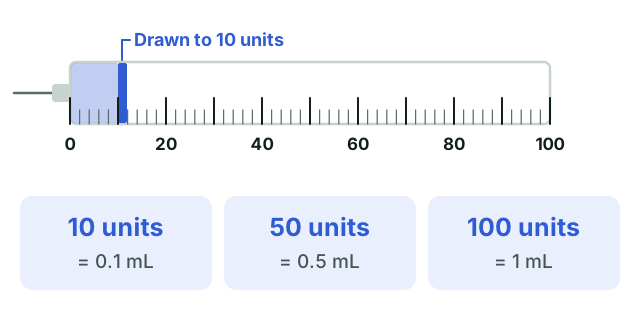
The vial size below is an example for the arithmetic, not a fact about any product.
| Example: 10 mg vial mixed with | Concentration | Peptide per unit (U-100) | 1.75 mg is |
|---|---|---|---|
| 1 mL | 10 mg/mL | 0.1 mg | 17.5 units (0.175 mL) |
| 2 mL | 5 mg/mL | 0.05 mg | 35 units (0.35 mL) |
| 3 mL | 3.33 mg/mL | 0.033 mg | 52.5 units (0.525 mL) |
The table describes arithmetic, not a dose. The mg/mL to units converter below does the same calculation for any concentration, and the reconstitution calculator starts from the vial size and the water added (see how to reconstitute).
mL and mg to units
100 units = 1 mLCommon PT-141 dosing mistakes
- Confusing mg and mcg. 1.75 mg is 1,750 mcg. Reading it as 1.75 mcg is a thousandfold error.
- Treating units as milligrams. A unit is a hundredth of a milliliter and holds whatever the concentration says.
- Copying another person’s units. 35 units is 1.75 mg only if the vial is at 5 mg/mL.
- Stacking doses. The label limit is one dose in 24 hours, whatever the product.
- Using it daily. Daily dosing is what produced skin darkening in 38% of women within 8 days.
- Trusting the vial label. Research-grade vials carry no FDA-verified identity, purity, potency or sterility.
Who should not use PT-141
The label contraindicates Vyleesi in uncontrolled high blood pressure and known cardiovascular disease, and does not recommend it for anyone at high risk of cardiovascular disease. It advises stopping if pregnancy is suspected, avoiding it with oral naltrexone for alcohol or opioid dependence, and caution in severe kidney or liver impairment, where nausea and vomiting may be worse. Side effects and cost are on the PT-141 overview.
Compare
- PeptidesFDA approvedPT-141PT-141 is bremelanotide, sold as Vyleesi and FDA-approved for low desire in premenopausal women.
- GoalsWomenThe peptides with real evidence for women are approved drugs with rules written for women: libido, the pill, pregnancy, bone.
- LearnFDA status trackerWhich peptides are FDA-approved, which HHS tolerates under conditions, and which are not legal to use.
Peptide news, sorted. Plus the printable dose chart.
Sorted, every Tuesday: the week's peptide and GLP-1 news in five minutes: FDA moves, new studies explained, and price changes. Subscribe and the one-page dose and injection-site chart arrives first.
Questions people ask
What is the normal PT-141 dose?
How often can PT-141 be used?
Where is PT-141 injected?
What dose of PT-141 do men use?
How many units is 1.75 mg of PT-141?
Does a higher dose work better?
Sources
Primary sources first: FDA labels and documents, peer-reviewed trials, registries.
- 1Vyleesi (bremelanotide injection) prescribing information, revised March 2024, via DailyMeddailymed.nlm.nih.gov
- 2Drugs@FDA. Vyleesi (bremelanotide), NDA 210557, approved June 21, 2019accessdata.fda.gov
- 3FDA. FDA approves new treatment for hypoactive sexual desire disorder in premenopausal women, June 21, 2019 (press release, via BioSpace)biospace.com
- 4Kingsberg SA et al. Bremelanotide for the treatment of hypoactive sexual desire disorder: two randomized phase 3 trials. Obstet Gynecol 2019pubmed.ncbi.nlm.nih.gov
- 5Rosen RC et al. Safety, pharmacokinetics and pharmacodynamic effects of subcutaneously administered PT-141 in healthy male subjects and in patients with an inadequate response to Viagra. Int J Impot Res 2004pubmed.ncbi.nlm.nih.gov
- 6Diamond LE et al. Double-blind, placebo-controlled evaluation of intranasal PT-141 in healthy males and patients with mild-to-moderate erectile dysfunction. Int J Impot Res 2004pubmed.ncbi.nlm.nih.gov
- 7Diamond LE et al. Co-administration of low doses of intranasal PT-141 and sildenafil to men with erectile dysfunction. Urology 2005pubmed.ncbi.nlm.nih.gov
- 8Drug Store News. Palatin to cut staff, cancel work on ED drugdrugstorenews.com
- 921 U.S.C. 353a, pharmacy compounding (section 503A)law.cornell.edu
- 10FDA. Guidance: compounded drug products that are essentially copies of a commercially available drug product under section 503A, January 2018fda.gov
- 11FDA warning letter 735063 to a peptide seller naming PT-141, August 24, 2026fda.gov
- 1221 CFR 312.160, drugs for investigational use in laboratory research animals or in vitro testslaw.cornell.edu
PeptideSorted Editorial Team
Editorial review
The PeptideSorted editors check every guide against its cited sources before publication: each number against its FDA label, trial or registry, the FDA status against current FDA and HHS documents, and the wording against our describe-never-prescribe rule. Licensed clinicians who join the review panel are listed by name on the editorial team page.
This page was checked against its cited sources by the PeptideSorted editorial team. Licensed clinicians on our review panel are listed on the editorial team page. Every health page cites primary sources and shows its review date. Read the editorial policy and how medical review works, or report an error via corrections. Educational only; not medical advice.