
Short answer
Tirzepatide starts at 2.5 mg once a week. Zepbound then moves to 5 mg after 4 weeks, and both labels allow further 2.5 mg increases after at least 4 weeks on each dose, up to 15 mg a week in adults. Zepbound's maintenance doses are 5, 10 or 15 mg. Your prescriber sets the pace.
- What it is
- A once-weekly injectable GIP and GLP-1 receptor agonist sold as Zepbound (weight management, sleep apnea) and Mounjaro (type 2 diabetes).
- FDA status
- FDA approved
Mounjaro approved May 2022 for type 2 diabetes and August 28, 2026 to lower major cardiovascular risk in adults with type 2 diabetes at high risk; Zepbound approved November 2023 for chronic weight management and December 2024 for obstructive sleep apnea.
- Evidence level
FDA label
Dosing comes from the FDA-approved prescribing information.
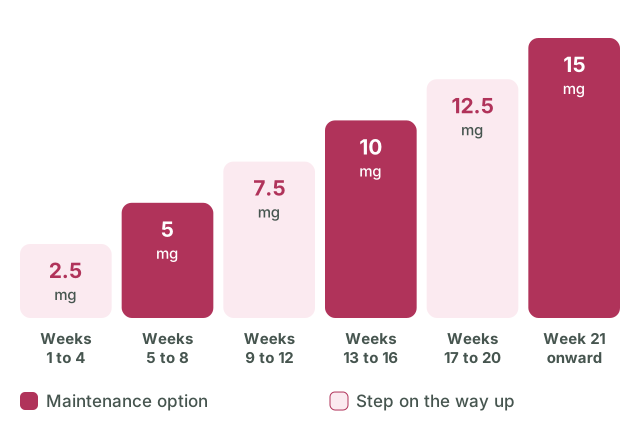
The tirzepatide label moves in six steps, from 2.5 mg to a maximum of 15 mg once a week, with at least 4 weeks on each. The chart below shows the fastest schedule the label allows. Plenty of people stop lower or stay longer, and your prescriber chooses the step. If you draw from a vial, the units calculator on this page converts your dose to syringe units.
The tirzepatide dosage chart
| Step | Dose (once weekly) | Earliest weeks | Label role |
|---|---|---|---|
| 1 | 2.5 mg | Weeks 1 to 4 | Starting dose. Not approved as a maintenance dose. |
| 2 | 5 mg | Weeks 5 to 8 | First treatment dose. Zepbound maintenance option for weight. |
| 3 | 7.5 mg | Weeks 9 to 12 | Step-up dose. |
| 4 | 10 mg | Weeks 13 to 16 | Zepbound maintenance option for weight and sleep apnea. |
| 5 | 12.5 mg | Weeks 17 to 20 | Step-up dose. |
| 6 | 15 mg | Week 21 onward | Adult maximum. Zepbound maintenance option for weight and sleep apnea. |
The roles above come from the Zepbound label. Mounjaro uses the same strengths and 4-week minimum, but its dose goes up only if more blood sugar control is needed.
How the pens and vials are supplied
A 5 mg dose is not the same amount of liquid in every product, and that catches people out. Single-dose pens and vials hold each dose in 0.5 mL. The KwikPen and multi-dose vial deliver each dose in 0.6 mL, so their concentrations are lower. Both the Zepbound and Mounjaro labels list all of these, though what a pharmacy stocks varies.
| Dose | Single-dose pen or vial (0.5 mL) | KwikPen or multi-dose vial (0.6 mL) |
|---|---|---|
| 2.5 mg | 5 mg/mL | 4.17 mg/mL |
| 5 mg | 10 mg/mL | 8.33 mg/mL |
| 7.5 mg | 15 mg/mL | 12.5 mg/mL |
| 10 mg | 20 mg/mL | 16.7 mg/mL |
| 12.5 mg | 25 mg/mL | 20.8 mg/mL |
| 15 mg | 30 mg/mL | 25 mg/mL |
With a pen you measure nothing. You still draw from a Lilly vial, but the volume never changes: 0.5 mL from a single-dose vial or 0.6 mL from a multi-dose vial, whatever the strength. On a syringe marked in units, those are the 50-unit and 60-unit lines.
Tirzepatide units calculator
Compounded vialsHow to convert tirzepatide mg to units
To find units, divide your dose in mg by the vial’s concentration in mg/mL, then multiply by 100. If your pharmacy sent a 20 mg/mL vial and your dose is 5 mg, that is 5 ÷ 20 × 100 = 25 units. This math is for compounded vials, where the volume changes with the dose.
| Dose | At 10 mg/mL | At 20 mg/mL | At 30 mg/mL |
|---|---|---|---|
| 2.5 mg | 25 units | 12.5 units | 8.3 units |
| 5 mg | 50 units | 25 units | 16.7 units |
| 7.5 mg | 75 units | 37.5 units | 25 units |
| 10 mg | 100 units | 50 units | 33.3 units |
These are examples, so read your own label first. The same 25-unit mark holds 2.5 mg at 10 mg/mL and 5 mg at 20 mg/mL.
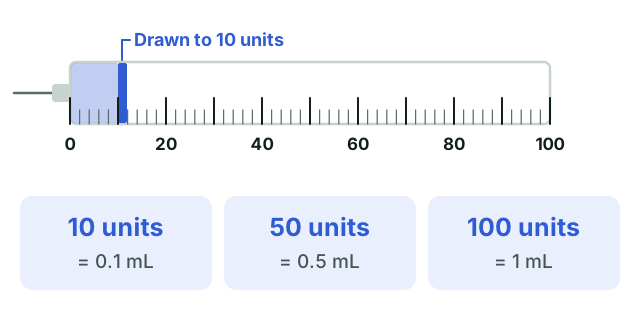
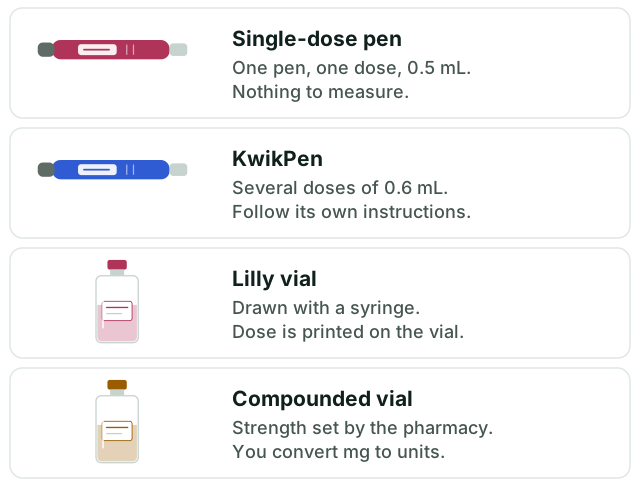
The mg/mL to units converter does the same arithmetic for other drugs, and the printable dosing chart keeps your own numbers in one place.
What happens at each dose step
The label names each step’s purpose, and the Zepbound trials show how the maintenance doses performed. In SURMOUNT-1, doses rose over up to 20 weeks, and weight was measured at 72 weeks.
| Dose | What the label or trials report |
|---|---|
| 2.5 mg | Lets your body adjust. A starting dose, not approved for maintenance. |
| 5 mg | Average weight loss of 15.0% at 72 weeks; 1.9% of people stopped because of stomach side effects. |
| 7.5 mg | A step toward higher doses. No maintenance group was tested at this dose in SURMOUNT-1. |
| 10 mg | Average weight loss of 19.5%; 3.3% stopped because of stomach side effects. |
| 12.5 mg | A step toward 15 mg. No maintenance group was tested at this dose in SURMOUNT-1. |
| 15 mg | Average weight loss of 20.9%; 4.3% stopped because of stomach side effects. |
Placebo groups lost 3.1% on average, and 0.5% stopped for stomach reasons. The stopping rates come from the pooled label data. The extra gain from 10 mg to 15 mg is much smaller than the gap between either dose and placebo, which helps explain why the label says to weigh treatment response and tolerability when choosing a maintenance dose.
Two things repeat at every step. Stomach side effects may flare, and the tirzepatide side effects guide covers what helps. And if you take birth control pills, the label advises a non-oral or added barrier method for 4 weeks after each increase.
Which tirzepatide dose is used for each condition?
The target depends on what the drug is treating, so the same milligram step can mean different things on different labels.
| Use | Brand | What the label says |
|---|---|---|
| Weight reduction and long-term maintenance | Zepbound | Maintenance of 5, 10 or 15 mg |
| Moderate-to-severe sleep apnea with obesity | Zepbound | Maintenance of 10 or 15 mg |
| Blood sugar in adults with type 2 diabetes | Mounjaro | Starts at 2.5 mg; up to 15 mg if more control is needed |
| Blood sugar in children 10 and older with type 2 diabetes | Mounjaro | Starts at 2.5 mg; up to 10 mg if more control is needed |
| Lowering major cardiovascular risk in high-risk adults with type 2 diabetes | Mounjaro | Same adult dosing; up to 15 mg |
Do you have to go all the way to 15 mg?
No. The label sets 15 mg as a ceiling, and for weight management 5 mg is already a maintenance dose. It says to consider treatment response and tolerability when choosing one, so reaching a higher step depends on how you are doing.
If a new dose is too much, the Zepbound label says a lower maintenance dose can be considered. A clinician consensus on GLP-1 drugs describes spending 2 to 4 more weeks on the previous dose, or a temporary pause, and avoiding increases while stomach symptoms persist. Those are options for your prescriber to weigh, and neither changes the label’s schedule.
Can you split a dose or take tirzepatide more often?
The label has no split-dose or twice-weekly schedule. Tirzepatide is once weekly, and the devices are built around one full dose. A single-dose pen delivers its whole contents. A KwikPen holds four fixed doses, and its instructions say to turn the dose knob all the way and not to move medicine into a syringe. The FDA also lists “taking doses more frequently” among the patterns behind adverse event reports with compounded semaglutide and tirzepatide.
How long do you stay on tirzepatide?
Zepbound has no set stop date, and its label covers maintaining weight reduction long term. The withdrawal trial shows why that matters. After 36 weeks on the drug, people switched to placebo regained 14.0% from that point by week 88, while those who stayed on it lost a further 5.5%. Stopping is still your decision to make with your prescriber, since reasons such as side effects, pregnancy or cost can all change the plan.
Why does each dose last at least 4 weeks?
Two reasons sit behind the 4-week minimum. The label says blood levels reach a steady state after 4 weeks of weekly dosing, so it takes that long for a dose to fully build up. It also says to follow the schedule to reduce the risk of stomach side effects.
The minimum is a floor. The label says the dose “may be increased” after at least 4 weeks and to consider a lower maintenance dose if one is not tolerated, so a prescriber can hold you at a step for longer. Mounjaro’s label works the same way, with increases only “if additional glycemic control is needed.”
When should you take tirzepatide?
Once a week, at any time of day, with or without food. The label does not favor mornings or evenings. Tirzepatide’s half-life is about 5 days, and blood levels peak a median of 24 hours after injection.
The injection day can move if you need it to, as long as the two doses stay at least 3 days (72 hours) apart.
What if you miss a dose?
The label gives you 4 days. The missed dose is taken as soon as possible within 96 hours. After that, it is skipped and the next dose goes on your usual day.
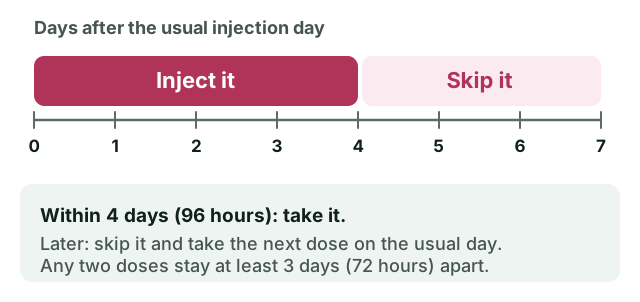
Say your dose day is Sunday. If you remember by Thursday, the label still allows that dose, then you go back to Sunday as normal. If it is Friday or later, the label says to skip it and wait for Sunday. If you cannot remember whether you injected, call your prescriber or pharmacist before taking another dose. The dose tracker makes that easier to check.
What if you miss several weeks?
The label does not say how to restart after a long gap, so this is a question for your prescriber before you inject. Lilly’s own trials give one reference point. In the SURPASS-CVOT protocol, people who missed 2 or fewer injections in a row resumed at the same dose. Those who missed 3 or more restarted at 5 mg, whatever dose they had been on, then climbed 2.5 mg every 4 weeks. That is a research rule, and it is neither label guidance nor a recommendation for you. It does mirror the ladder, which the label uses to reduce stomach side effects.
What if you take too much?
Lilly’s safety summary says to call your provider, call Poison Help at 1-800-222-1222, or go to the nearest emergency room right away. The label adds that observation and treatment may be needed for a while, because tirzepatide’s half-life is about 5 days. An accidental extra dose is worth a phone call, even if you feel fine.
Switching from semaglutide or another GLP-1
Lilly says the recommended starting dose of Zepbound is 2.5 mg and that anyone switching from another medicine should talk to their provider about the right approach. The label has no conversion table between drugs, so a dose of semaglutide does not translate to a set dose of tirzepatide. The label also advises against using Zepbound with another tirzepatide product or any GLP-1 drug.
Do weight, age, kidneys or liver change the dose?
The label’s schedule is fixed. It has no weight-based dosing, and it recommends no dose change for kidney or liver impairment. People 65 and older showed no overall differences in safety or effectiveness in the weight trials.
Mounjaro has one exception: children 10 and older have a maximum of 10 mg, and the KwikPen is not recommended for children to use on their own. The Zepbound label has not established safety or effectiveness in children at all. Mounjaro’s newer cardiovascular indication, approved August 28, 2026, did not add a separate schedule; the trial climbed 2.5 mg every 4 weeks to 15 mg or the highest tolerated dose.
Common tirzepatide dosing mistakes
- Treating units as milligrams. Units measure liquid. The same number of units holds a different dose in every concentration.
- Reusing a volume after a product change. 5 mg is 0.5 mL in a single-dose pen and 0.6 mL in a KwikPen, and compounded vials differ again. The label calls for training whenever the presentation changes.
- Climbing faster than the label. The FDA has received adverse event reports that may be linked to compounded tirzepatide prescribed at higher doses, or increased more quickly, than the label.
- Doubling up after a missed dose. Two doses should be at least 3 days apart.
- Staying on 2.5 mg as a long-term dose. The label says it is not approved for maintenance. Very low or spaced-out schedules are covered in the GLP-1 microdosing guide.
- Using what is left in a KwikPen. The instructions say to throw it away after 4 doses, not to inject the leftover, and not to transfer medicine into a syringe.
- Injecting cloudy or discolored liquid. The solution should be clear and colorless to slightly yellow. The label says not to use it if you see particles or discoloration.
If you were prescribed compounded tirzepatide
Compounded tirzepatide comes in vials at a concentration set by the pharmacy, so the dose in mg stays the same and the number of units changes with each vial. That is why the calculator asks you to enter your concentration. The FDA also recommends throwing out a multi-dose vial 28 days after first use, even if medicine remains and even if the compounder’s instructions allow longer. The compounded tirzepatide guide covers legal status and what to check on the vial.
Who should not follow this schedule at all
Tirzepatide carries a boxed warning about thyroid C-cell tumors seen in rats. The label says it must not be used by anyone with a personal or family history of medullary thyroid carcinoma or with Multiple Endocrine Neoplasia syndrome type 2, or by anyone with a known serious allergy to tirzepatide or its ingredients. It is not recommended with severe gastroparesis, and neither label covers type 1 diabetes. Past pancreas problems are something to raise before starting. These are prescriber decisions, which is one more reason this table is information and not an instruction.
Compare
- GLP-1sFDA approvedSide effectsNausea hits 25% to 29% of people on Zepbound, mostly during dose increases.
- GLP-1sFDA approvedCompounded tirzepatideCompounded tirzepatide is legal only in narrow cases since the shortage ended.
- GLP-1sFDA approvedInjection sitesZepbound and Mounjaro go in the stomach, thigh or back of the upper arm, with similar exposure at each.
Getting tirzepatide legitimately
Affiliate disclosure: some links below pay us a referral fee. It never changes the price you pay or the order we list providers.
Through your own doctor
Any licensed prescriber can write a prescription for an FDA-approved GLP-1 if you meet the label criteria. Insurance coverage for weight management varies; ask the office to run a benefits check first.
Through a telehealth provider
Look for a real consultation with a licensed clinician, a named pharmacy, and a clear statement of whether you are getting the brand product or a compounded version. Avoid any site that ships without a consult.
Provider comparison coming once we have verified pricing and pharmacy sourcing for each program. Until then, the two routes above are the only ones we recommend.
Peptide news, sorted. Plus the printable dose chart.
Sorted, every Tuesday: the week's peptide and GLP-1 news in five minutes: FDA moves, new studies explained, and price changes. Subscribe and the one-page dose and injection-site chart arrives first.
Questions people ask
How long do you stay on 2.5 mg of tirzepatide?
Can you stay on 5 mg of tirzepatide?
Can you skip a step and go straight to 10 mg?
What if I miss a tirzepatide dose?
Is 15 mg the highest tirzepatide dose?
How many units is 2.5 mg of tirzepatide?
Sources
Primary sources first: FDA labels and documents, peer-reviewed trials, registries.
- 1Eli Lilly. Zepbound (tirzepatide) prescribing information and instructions for use, revised August 2026, read Nov 2 2026uspl.lilly.com
- 2Eli Lilly. Mounjaro (tirzepatide) prescribing information, revised August 2026, read Nov 2 2026uspl.lilly.com
- 3Eli Lilly press release: FDA approves Lilly's Mounjaro (tirzepatide) to reduce cardiovascular risk in adults with type 2 diabetes, Aug 28 2026investor.lilly.com
- 4Eli Lilly. LillyDirect Zepbound page: which dose to start on when switching (CMAT-05333 08/2026), read Nov 2 2026lilly.com
- 5Eli Lilly. Protocol I8F-MC-GPGN(f), SURPASS-CVOT, Section 7.4.3 on reinitiating study drug, via ClinicalTrials.govcdn.clinicaltrials.gov
- 6Gorgojo-Martinez JJ et al. Clinical recommendations to manage gastrointestinal adverse events in patients treated with GLP-1 receptor agonists: a multidisciplinary expert consensus. J Clin Med 2023pmc.ncbi.nlm.nih.gov
- 7Jastreboff AM et al. Tirzepatide once weekly for the treatment of obesity (SURMOUNT-1). N Engl J Med 2022nejm.org
- 8FDA press release: FDA approves new medication for chronic weight management (Zepbound), Nov 8 2023fda.gov
- 9FDA. FDA's concerns with unapproved GLP-1 drugs used for weight loss, current as of Oct 1 2026fda.gov
More on Tirzepatide
- OverviewTirzepatideTirzepatide is the weekly GIP/GLP-1 injection in Zepbound and Mounjaro. See who it suits, average weight loss, side effects, real prices and what to ask.
- Cheapest onlineThe lowest legitimate online price for tirzepatide is Lilly's own: $299 to $449 a month with a prescription. See prices by dose and the red flags to avoid.Read
- Compounded tirzepatideCompounded tirzepatide is legal only in narrow cases since the shortage ended. See current FDA rules, recent enforcement, vial checks and a units table.Read
- CostTirzepatide runs from $25 with coverage to $449 cash and $1,086 at list price. See every route, Medicare's $50 option and how to pay less.Read
- Injection sitesZepbound and Mounjaro go in the stomach, thigh or back of the upper arm, with similar exposure at each. See how to rotate and how each device works.Read
- Side effectsNausea hits 25% to 29% of people on Zepbound, mostly during dose increases. See every label rate by dose, what eases symptoms and which ones need a call.Read
PeptideSorted Editorial Team
Editorial review
The PeptideSorted editors check every guide against its cited sources before publication: each number against its FDA label, trial or registry, the FDA status against current FDA and HHS documents, and the wording against our describe-never-prescribe rule. Licensed clinicians who join the review panel are listed by name on the editorial team page.
This page was checked against its cited sources by the PeptideSorted editorial team. Licensed clinicians on our review panel are listed on the editorial team page. Every health page cites primary sources and shows its review date. Read the editorial policy and how medical review works, or report an error via corrections. Educational only; not medical advice.