Short answer
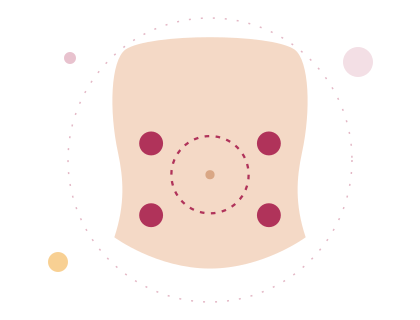
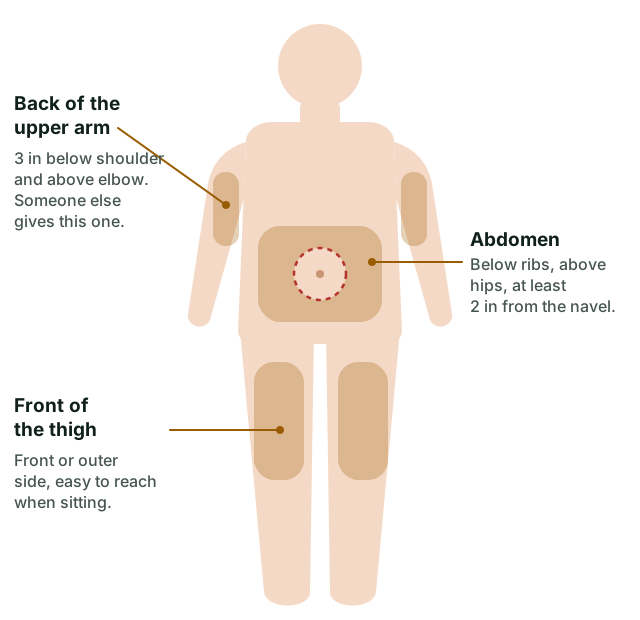
Zepbound and Mounjaro are injected under the skin of the stomach, at least 2 inches from the belly button; the thigh; or the back of the upper arm, which another person should inject. The label reports similar drug exposure at all three. A different spot is used each week. The sites are the same for pen, KwikPen and vial.
- What it is
- The FDA-approved injection sites and steps for tirzepatide (Zepbound, Mounjaro), a once-weekly subcutaneous injection.
- FDA status
- FDA approved
Zepbound approved November 2023 (weight management) and December 2024 (sleep apnea); Mounjaro approved May 2022 (type 2 diabetes) and August 28, 2026 (lowering major cardiovascular risk in adults with type 2 diabetes at high risk). Zepbound is sold as a single-dose pen, a 4-dose KwikPen and a single-dose vial, each with its own FDA-approved Instructions for Use.
- Evidence level
FDA label
Dosing comes from the FDA-approved prescribing information.
Tirzepatide is injected under the skin once a week, and Lilly’s FDA-approved instructions for Zepbound and Mounjaro name the same three places: the stomach, the thigh and the back of the upper arm. The prescribing information adds one rule that applies everywhere: rotate injection sites with each dose. All three sites gave similar drug exposure, so the choice comes down to comfort and who is doing the injecting. What differs between devices is how the dose gets in.
Where to inject Zepbound and Mounjaro
| Site | Exactly where | Who can inject it | From the instructions |
|---|---|---|---|
| Stomach (abdomen) | At least 2 inches from the belly button | You or another person | The 2-inch distance is stated in the KwikPen instructions |
| Thigh | The thigh | You or another person | Listed in the Zepbound and Mounjaro instructions |
| Back of the upper arm | The back of the upper arm | Another person | “Another person should give you the injection in the back of your upper arm” |
All three are subcutaneous, meaning into the fat layer under the skin. Lilly’s safety summary says not to inject into a muscle or a vein. If you take insulin with Mounjaro, the label says the two can go in the same body area but not right next to each other, and must never be mixed in one injection.
Does it matter where you inject?
For how much drug reaches your blood, the label says no. “Similar exposure was achieved” with injection in the abdomen, thigh or upper arm, so there is no labeled reason to favor one site for better results. Your healthcare provider can help you choose, and the pen instructions say exactly that.
How to rotate Zepbound injection sites
The pen and KwikPen instructions say to change the injection site each week. You may stay in the same body area, as long as you choose a different spot within it. The vial instructions explain why: rotating lowers the risk of lipodystrophy, which is pits or thickening in the skin, and localized cutaneous amyloidosis, which is lumps at the injection site.
The vial instructions also list places to skip:
- Skin with pits, thickening or lumps
- Skin that is tender, bruised, scaly or hard
- Scars or damaged skin
Keeping a note of each week’s site makes rotation easier. The dose tracker does this, and the general injection sites guide includes a simple 8-week rotation pattern that fits a weekly drug.
Pen, KwikPen or vial: what changes
Lilly sells Zepbound in three forms, and the label also lists a multi-dose vial. The sites are identical, but the technique is not. The label calls for training on the specific form you receive, and again if it changes.
| Single-dose pen | KwikPen | Single-dose vial | |
|---|---|---|---|
| Doses per device | 1 | 4, one per week | 1 |
| Needle | Built in and hidden | New pen needle each week, sold separately | New syringe and needle each week, sold separately |
| Before injecting | Pull off the gray base cap; the pen stays locked until it is on your skin | Attach needle, then prime: dial to the prime position, push and count to 5 until a drop appears | Wipe stopper, draw 0.5 mL of air, inject it into the vial, then draw the liquid to the 0.5 mL line |
| Setting the dose | Fixed | Turn the dose knob all the way until it stops; “Do not count clicks” | Fixed at 0.5 mL per vial |
| Injecting | Place clear base flat on the skin, turn the lock ring, press and hold up to 10 seconds until the second click | Insert needle, push the knob in until it stops, count slowly to 5 | Insert needle, push the plunger, keep the needle in at least 5 seconds |
| Confirming the dose | Gray plunger visible | Dose icon shown in the window | The 5-second hold is “to make sure you have injected all of your dose” |
| Pinching the skin | Not described | Not described | “Your healthcare provider should tell you if you should pinch the skin” |
| After | Whole pen into a sharps container | Recap and unscrew the needle into a sharps container; throw the pen away after 4 doses or 30 days from first use | Do not recap the needle; throw the vial away after one use even if liquid is left |
A few details people commonly ask about:
- Check the liquid first. It should be clear and colorless to slightly yellow. The label says not to use it if you see particles or discoloration.
- Pen temperature. The instructions say it is not necessary to warm the pen before injecting, and that air bubbles in the pen are normal.
- Pen mishaps. If the button is pressed before the gray base cap comes off, the instructions say to leave the cap on, throw the pen away and get a new one. Once removed, the cap should not go back on. A drop of liquid on the needle tip is normal.
- Extra clicks. Some people hear a soft click just before the second loud click. That is normal, and the pen stays on the skin until the second loud click.
- Multi-dose vial. Each holds 4 doses of 0.6 mL, with a new syringe and needle every week. The vial instructions say not to mix Zepbound with any other medicine.
- KwikPen leftovers. Some medicine stays in the pen after the fourth dose. The instructions say to throw the pen away with it, not to inject the leftover, and not to transfer medicine from the pen into a syringe.
- KwikPen sharing. The label warns against sharing one between people, even with a new needle, because of the risk of blood-borne infection.
- Vision problems. The label says the KwikPen is not recommended for self-injection by people who are visually impaired. The pen instructions say not to use the pen without help from someone trained on it.
- Vial units. A single-dose vial dose is 0.5 mL regardless of strength, and a multi-dose vial dose is 0.6 mL. On a U-100 insulin syringe those are the 50-unit and 60-unit lines. Compounded tirzepatide is different, and the tirzepatide units calculator handles that case.
How to store Zepbound
Storage rules differ by device. Every form should be kept from freezing, heat and light, in the original carton. If Zepbound has been frozen, the label says not to use it.
| Form | In the fridge (36°F to 46°F) | At room temperature (up to 86°F) |
|---|---|---|
| Single-dose pen or vial | Standard storage | Up to 21 days in total, then discard |
| Unopened KwikPen or multi-dose vial | Until the expiration date | Discard after 30 days |
| Opened KwikPen or multi-dose vial | Allowed, in the original carton | Allowed, in the original carton |
An opened KwikPen or multi-dose vial is discarded after a total of 30 days at room temperature, 30 days after first use, or 4 weekly doses, whichever comes first, even if medicine is left.
After the injection
If you see a drop of blood or liquid, the instructions say to press the site lightly with gauze or a cotton ball and not to rub it. Used pens, pen needles and syringes go straight into an FDA-cleared sharps container. If you do not have one, a heavy-duty plastic household container with a tight, puncture-resistant lid can be used. The instructions say not to recycle it, and to follow local rules when it is nearly full.
What to watch for at the injection site
Injection site reactions affected 6% to 8% of people on Zepbound in the weight trials, against 2% on placebo. They include bruising, redness, itching, pain and rash. Worth reporting to your prescriber are spreading redness, warmth or swelling, a lump that persists or grows, or skin changes at a site you use often, which is what rotation is meant to prevent.
Swelling of the face, lips, tongue or throat, or trouble breathing, is an emergency. Lilly’s safety summary says to stop Zepbound and get medical help right away. The tirzepatide side effects guide covers the drug’s other warnings, including the boxed thyroid warning and who should not use it. The dose itself is set by your prescriber, and the tirzepatide dosage chart shows the labeled schedule.
Compare
- LearnInjection sitesMost peptide drugs go under the skin of the abdomen or thigh, and some labels add the upper arm.
- GLP-1sFDA approvedSide effectsNausea hits 25% to 29% of people on Zepbound, mostly during dose increases.
- GLP-1sFDA approvedDosage chartThe label takes tirzepatide from 2.5 mg to as high as 15 mg weekly in 4-week steps.
Getting tirzepatide legitimately
Affiliate disclosure: some links below pay us a referral fee. It never changes the price you pay or the order we list providers.
Through your own doctor
Any licensed prescriber can write a prescription for an FDA-approved GLP-1 if you meet the label criteria. Insurance coverage for weight management varies; ask the office to run a benefits check first.
Through a telehealth provider
Look for a real consultation with a licensed clinician, a named pharmacy, and a clear statement of whether you are getting the brand product or a compounded version. Avoid any site that ships without a consult.
Provider comparison coming once we have verified pricing and pharmacy sourcing for each program. Until then, the two routes above are the only ones we recommend.
Peptide news, sorted. Plus the printable dose chart.
Sorted, every Tuesday: the week's peptide and GLP-1 news in five minutes: FDA moves, new studies explained, and price changes. Subscribe and the one-page dose and injection-site chart arrives first.
Questions people ask
Is it better to inject Zepbound in the stomach or the thigh?
How far from the belly button do I inject Zepbound?
Can I inject Zepbound in my own arm?
How many units is a Zepbound vial dose?
Should I rub the spot after injecting?
Can Zepbound stay out of the fridge?
Sources
Primary sources first: FDA labels and documents, peer-reviewed trials, registries.
- 1Zepbound (tirzepatide) prescribing information, sections 2.4, 5.10, 12.3 and 16.2, Eli Lilly, revised 8/2026uspl.lilly.com
- 2Zepbound single-dose pen Instructions for Use, Eli Lilly, FDA-approveduspl.lilly.com
- 3Zepbound single-dose vial Instructions for Use, Eli Lilly, FDA-approveduspl.lilly.com
- 4Zepbound KwikPen Instructions for Use, Eli Lilly, FDA-approveduspl.lilly.com
- 5Mounjaro (tirzepatide) prescribing information, section 2.2, Eli Lilly, revised 8/2026uspl.lilly.com
- 6Mounjaro (tirzepatide) single-dose pen Instructions for Use, Eli Lillyuspl.lilly.com
- 7Eli Lilly press release: FDA approves Lilly's Mounjaro (tirzepatide) to reduce cardiovascular risk in adults with type 2 diabetes, Aug 28 2026investor.lilly.com
- 8Eli Lilly. LillyDirect Mounjaro page: safety summary, how to take (CMAT-26577 08/2026), read Nov 2 2026lilly.com
- 9Eli Lilly. LillyDirect Zepbound page: KwikPen, vial and pen supplies (CMAT-05333 08/2026), read Nov 2 2026lilly.com
More on Tirzepatide
- OverviewTirzepatideTirzepatide is the weekly GIP/GLP-1 injection in Zepbound and Mounjaro. See who it suits, average weight loss, side effects, real prices and what to ask.
- Cheapest onlineThe lowest legitimate online price for tirzepatide is Lilly's own: $299 to $449 a month with a prescription. See prices by dose and the red flags to avoid.Read
- Compounded tirzepatideCompounded tirzepatide is legal only in narrow cases since the shortage ended. See current FDA rules, recent enforcement, vial checks and a units table.Read
- CostTirzepatide runs from $25 with coverage to $449 cash and $1,086 at list price. See every route, Medicare's $50 option and how to pay less.Read
- Dosage chartThe label takes tirzepatide from 2.5 mg to as high as 15 mg weekly in 4-week steps. See the full chart, missed-dose rules and a mg-to-units calculator.Read
- Side effectsNausea hits 25% to 29% of people on Zepbound, mostly during dose increases. See every label rate by dose, what eases symptoms and which ones need a call.Read
PeptideSorted Editorial Team
Editorial review
The PeptideSorted editors check every guide against its cited sources before publication: each number against its FDA label, trial or registry, the FDA status against current FDA and HHS documents, and the wording against our describe-never-prescribe rule. Licensed clinicians who join the review panel are listed by name on the editorial team page.
This page was checked against its cited sources by the PeptideSorted editorial team. Licensed clinicians on our review panel are listed on the editorial team page. Every health page cites primary sources and shows its review date. Read the editorial policy and how medical review works, or report an error via corrections. Educational only; not medical advice.