
Short answer
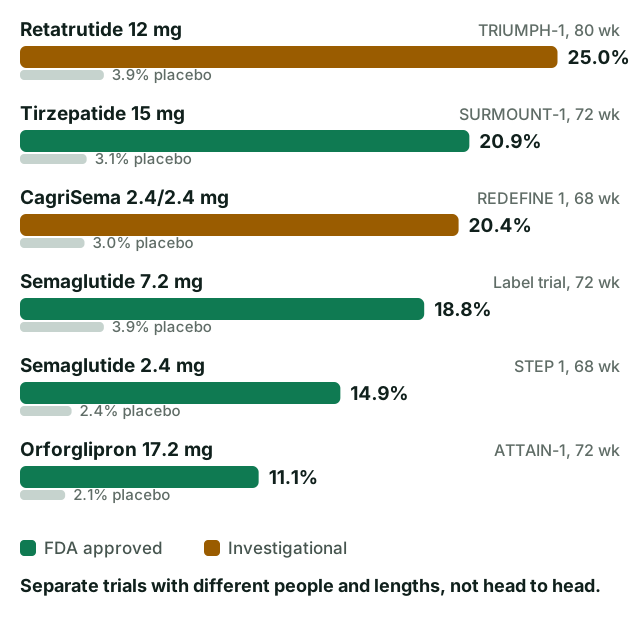
Tirzepatide is the one you can actually get: it is FDA-approved as Zepbound and Mounjaro, while retatrutide is still investigational. In separate trials, tirzepatide 15 mg produced 20.9% average weight loss at 72 weeks and retatrutide 12 mg produced 25.0% at 80 weeks. No trial has reported a direct comparison yet; TRIUMPH-5 is testing one.
- What it is
- A comparison of two once-weekly Eli Lilly injectables: tirzepatide (approved, dual GIP and GLP-1 agonist) and retatrutide (investigational, triple GIP, GLP-1 and glucagon agonist).
- FDA status
- Not a drug
Tirzepatide: approved (Mounjaro May 2022, Zepbound November 2023). Retatrutide: not approved; Lilly plans to submit it to the FDA in Q1 2027.
- Evidence level
Phase 3 trials
Large randomized human trials have been completed.
Choose by what exists. Tirzepatide is an FDA-approved drug you can get with a prescription today. Retatrutide is an investigational drug that cannot be bought or prescribed normally; outside clinical trials there is only a narrow compassionate use program. On trial numbers, retatrutide’s top dose looks likely to take off more weight, with more stomach side effects and more people stopping. That is an estimate from separate trials, because the direct comparison has not reported. Both are once-weekly injections from Eli Lilly.
Tirzepatide vs retatrutide, side by side
| Tirzepatide | Retatrutide | |
|---|---|---|
| Brand names | Zepbound (weight, sleep apnea), Mounjaro (type 2 diabetes) | None yet |
| Maker | Eli Lilly | Eli Lilly |
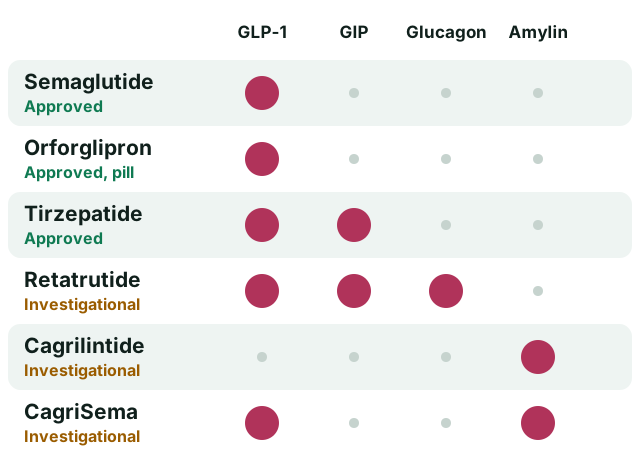
| Receptors it activates | GIP and GLP-1 (dual agonist) | GIP, GLP-1 and glucagon (triple agonist) |
| FDA status | Approved: Mounjaro May 2022; Zepbound November 8, 2023 (weight) and December 20, 2024 (obstructive sleep apnea) | Not approved. Lilly plans a Biologics License Application in Q1 2027 |
| How it is given | Once-weekly injection under the skin | Once-weekly injection under the skin (in trials) |
| Dose range | Label: 2.5 mg start for 4 weeks, then up in 2.5 mg steps every 4 weeks or more, to 5, 10 or 15 mg maintenance | Trials: 2 mg start, then 4, 6 and 9 mg every 4 weeks, to a target of 4, 9 or 12 mg |
| Main obesity trial | SURMOUNT-1: 2,539 adults without diabetes, 72 weeks | TRIUMPH-1: 2,339 adults without diabetes, 80 weeks |
| Average weight change, main obesity trial | 5 mg -15.0%, 10 mg -19.5%, 15 mg -20.9%; placebo -3.1% | 4 mg -17.6%, 9 mg -23.7%, 12 mg -25.0%; placebo -3.9% |
| Trial in type 2 diabetes | SURMOUNT-2: 938 adults, 72 weeks; 10 mg -12.8%, 15 mg -14.7%; placebo -3.2% | TRIUMPH-2: 1,152 adults, 80 weeks; 4 mg -11.9%, 9 mg -16.8%, 12 mg -18.8%; placebo -5.1% |
| Sleep apnea | Approved for moderate-to-severe obstructive sleep apnea with obesity | In TRIUMPH-1’s sleep apnea sub-study, breathing events fell by 34.3 and 31.7 per hour on 9 and 12 mg versus 9.9 on placebo |
| Heart | Mounjaro approved in 2026 to reduce cardiovascular risk in adults with type 2 diabetes at high risk | TRIUMPH-3 could not show whether it raises or lowers heart risk; an outcomes trial is running |
| Nausea, top dose versus placebo | 15 mg: 28% versus 8% (Zepbound label, pooled weight trials) | 12 mg: 42.4% versus 14.8% (TRIUMPH-1, Lilly topline) |
| Vomiting, top dose versus placebo | 15 mg: 13% versus 2% | 12 mg: 25.3% versus 4.8% |
| Stopped because of side effects | 4.8% to 6.7% versus 3.4% on placebo | 4.1% to 11.3% versus 4.9% on placebo |
| Dysesthesia (burning or altered skin sensation) | 0.2% to 0.4% versus 0.1% on placebo | 5.1% to 12.5% versus 0.9% in TRIUMPH-1 |
| Safety warnings | Boxed warning for thyroid C-cell tumors in rats; contraindicated with a personal or family history of medullary thyroid carcinoma or MEN 2 | No label yet. Trials excluded people with those histories and with past pancreatitis |
| Access | Prescription from a licensed prescriber, filled by a licensed pharmacy | Clinical trials. Lilly also runs a narrow compassionate use program that physicians apply to |
All weight figures above are treatment-regimen estimates, which count everyone randomized whether or not they kept taking the drug. Lilly’s retatrutide press releases lead with a different measure, the efficacy estimand, which estimates the effect had everyone stayed on the drug and gave 28.3% for 12 mg in TRIUMPH-1. Putting that number next to tirzepatide’s 20.9% compares two different measures and overstates the gap.
Who each one suits, as things stand
Tirzepatide suits adults who want a treatment now and meet the label: obesity, or overweight with a weight-related condition, or moderate-to-severe sleep apnea with obesity for Zepbound, and type 2 diabetes for Mounjaro. It has years of real-world use, a full label and a known price. It is not for anyone with a personal or family history of medullary thyroid carcinoma or MEN 2. Those choices belong with a prescriber, and semaglutide sits on the same list of approved options.
Retatrutide suits two groups today: people who may qualify for a trial, and people following the science to judge whether waiting makes sense. A narrow compassionate use program also exists for adults with refractory obesity and serious complications who cannot join a trial, but a physician has to apply, reach is limited, and some obesity specialists want more safety data before using it.
What the comparison cannot tell you
The two obesity trials look similar, but they are not the same experiment.
- Different lengths. SURMOUNT-1 ran 72 weeks and TRIUMPH-1 ran 80. Eight extra weeks of treatment is a real difference when comparing totals.
- Different people. TRIUMPH-1’s participants started at an average weight of 112.7 kg and a BMI of 40.0, according to Lilly. Enrollment rules, countries and background care also differed between the programs.
- Different years and settings. SURMOUNT-1 was published in 2022; the TRIUMPH program began in 2023. Placebo groups behaved differently, too: placebo nausea was 14.8% in TRIUMPH-1 against 8% in the tirzepatide label trials, which suggests side effects were recorded or experienced differently.
- Different estimands in headlines. Press releases and papers often use different statistical approaches, as explained above. Mixing them inflates or shrinks the gap.
- Different time on the market. Tirzepatide’s safety record comes from a label and years of prescribing. Retatrutide’s comes from trials alone, and rare problems often appear only after a drug reaches many more people.
The fix is a direct trial. TRIUMPH-5 (NCT06662383) randomized about 800 adults with obesity to retatrutide or tirzepatide, double-blind, with percent weight change at 80 weeks as the primary outcome. ClinicalTrials.gov lists its primary completion as November 2026, and we found no results as of November 2. Retatrutide’s only reported head-to-head so far is against Ozempic 2 mg in type 2 diabetes, where 12 mg lowered A1c by 2.2 points versus 1.8 and weight by 20.9% versus 9.4% at 80 weeks (Lilly topline, efficacy estimand, open-label). That says nothing directly about tirzepatide.
Does type 2 diabetes change the picture?
Yes: both drugs take off less weight in people with type 2 diabetes. Tirzepatide 15 mg produced 14.7% in SURMOUNT-2, against 20.9% in people without diabetes. Retatrutide 12 mg produced 18.8% in TRIUMPH-2, against 25.0%. For someone with diabetes the bigger difference today is regulatory: Mounjaro is approved for it, and retatrutide is not, although Lilly’s TRANSCEND trials are testing that use.
What happens if you stop?
Tirzepatide has an answer and retatrutide does not yet. In SURMOUNT-4, adults who took tirzepatide for 36 weeks and then switched to placebo regained 14.0% over the next year, while those who stayed on it lost another 5.5%. We found no published retatrutide withdrawal result. Regain after stopping has been seen across weight-loss drug classes, so it would be surprising if retatrutide were different, but that is an expectation, not data.
How the mechanisms differ
Both drugs copy gut hormones that the body releases after eating. GLP-1 (glucagon-like peptide-1) and GIP (glucose-dependent insulinotropic polypeptide) boost insulin after meals, slow the stomach and signal fullness to the brain. Tirzepatide activates both.
Retatrutide also activates the receptor for glucagon, a pancreatic hormone that normally raises blood sugar between meals. The phase 2 authors wrote that adding glucagon activity “may further reduce energy intake, increase energy expenditure, or both.” Glucagon and GLP-1 can also raise heart rate, which is one reason heart rate is tracked closely in the retatrutide program. The retatrutide side effects page has the phase 2 heart rate and rhythm data.
Are 12 mg of retatrutide and 15 mg of tirzepatide comparable?
No, the milligram numbers are not interchangeable. Tirzepatide’s top dose is 15 mg; retatrutide’s is 12 mg. They are different molecules with different potency at each receptor, so 12 mg of one is not “less” than 15 mg of the other. Both are stepped up gradually, and both the trials and the tirzepatide label use four-week steps, because stomach side effects cluster in the weeks after each increase. The tirzepatide dosage chart sets out the approved ladder, and retatrutide dosing sets out the trial ladders.
Availability and cost
Tirzepatide is available now as Zepbound and Mounjaro, with Zepbound also sold through Lilly’s self-pay channel. The tirzepatide cost guide covers list prices, self-pay and insurance, and the cheapest GLP-1 without insurance page compares options across drugs.
Retatrutide has no price, no brand name and no retail source. Lilly says it “cannot be legally sold or marketed for human use,” and the FDA says it cannot be used in compounding. Vials sold online as “research use only” retatrutide are not legal to use on people, whatever the label says; the FDA has warned sellers, and calls these products “of unknown quality.” The FDA status tracker will record Lilly’s filing and the FDA’s decision.
Waiting has its own trade-offs. Retatrutide has no approval date, and an approved drug can be started now and changed later if something better arrives. Another investigational option, Novo Nordisk’s amylin-based cagrilintide, combined with semaglutide as CagriSema, is further along: Novo filed for FDA approval in December 2025.
Compare
Recent news on this
Peptide news, sorted. Plus the printable dose chart.
Sorted, every Tuesday: the week's peptide and GLP-1 news in five minutes: FDA moves, new studies explained, and price changes. Subscribe and the one-page dose and injection-site chart arrives first.
Questions people ask
Is retatrutide stronger than tirzepatide?
Can I switch from tirzepatide to retatrutide?
Which has more side effects?
What if tirzepatide stops working for me?
When will the head-to-head trial report?
Sources
Primary sources first: FDA labels and documents, peer-reviewed trials, registries.
- 1Jastreboff AM et al. Tirzepatide once weekly for the treatment of obesity (SURMOUNT-1). N Engl J Med 2022pubmed.ncbi.nlm.nih.gov
- 2Garvey WT et al. Tirzepatide once weekly for obesity in people with type 2 diabetes (SURMOUNT-2). Lancet 2023;402:613-626pubmed.ncbi.nlm.nih.gov
- 3Zepbound (tirzepatide) prescribing information, Eli Lilly, revised 8/2026, via DailyMeddailymed.nlm.nih.gov
- 4FDA press release: FDA approves new medication for chronic weight management (Zepbound), Nov 8 2023fda.gov
- 5FDA press release: FDA approves first medication for obstructive sleep apnea (Zepbound), Dec 20 2024fda.gov
- 6Aronne LJ et al. Continued treatment with tirzepatide for maintenance of weight reduction in adults with obesity (SURMOUNT-4). JAMA 2024;331:38-48pubmed.ncbi.nlm.nih.gov
- 7Eli Lilly. Zepbound list and self-pay pricespricinginfo.lilly.com
- 8Eli Lilly. Form 10-Q for the quarter ended September 30, 2026, filed October 29, 2026 (Mounjaro cardiovascular approval)sec.gov
- 9Jastreboff AM et al. Triple-hormone-receptor agonist retatrutide for obesity: a phase 2 trial. N Engl J Med 2023pubmed.ncbi.nlm.nih.gov
- 10Jastreboff AM et al. Retatrutide, a triple hormone receptor agonist, for treatment of obesity (TRIUMPH-1). N Engl J Med, published online September 29, 2026pubmed.ncbi.nlm.nih.gov
- 11Bellido V et al. Retatrutide in adults with obesity and type 2 diabetes (TRIUMPH-2). Lancet 2026;408:1455-1472pubmed.ncbi.nlm.nih.gov
- 12Grunstein RR et al. Retatrutide once weekly for treatment of obstructive sleep apnea. N Engl J Med, published online October 21, 2026pubmed.ncbi.nlm.nih.gov
- 13Eli Lilly press release (topline). TRIUMPH-1 adverse events and dose design, May 21, 2026investor.lilly.com
- 14Eli Lilly press release (topline). TRIUMPH-2 and TRIUMPH-3 results and BLA plans, July 23, 2026 (via BioSpace)biospace.com
- 15Eli Lilly press release (topline). TRANSCEND-T2D-2 head-to-head results against Ozempic 2 mg, October 28, 2026investor.lilly.com
- 16ClinicalTrials.gov NCT06662383. TRIUMPH-5: retatrutide compared with tirzepatide in adults with obesityclinicaltrials.gov
- 17ClinicalTrials.gov NCT07629401. Pre-approval expanded access of retatrutide (LY3437943)clinicaltrials.gov
- 18AJMC. Lilly expands retatrutide access amid doctor pushback, August 5, 2026ajmc.com
- 19FDA. FDA's concerns with unapproved GLP-1 drugs used for weight loss, content current as of October 1, 2026fda.gov
More in GLP-1s
- CagrilintideCagrilintide is an unapproved amylin drug. Paired with semaglutide as CagriSema, it is under FDA review. No decision yet. See results and side effects.Read
- Cheapest without insuranceThe cheapest GLP-1 without insurance starts at $149 a month, but that buys a starter dose. Compare Wegovy, Zepbound and Foundayo at the dose you keep.Read
- MicrodosingNo trial has tested GLP-1 microdosing. Low doses still bring some weight loss, far less than full doses. See the evidence, units risk and other options.Read
- OrforglipronFoundayo (orforglipron) is a daily GLP-1 pill approved in April 2026. Label doses, 11.1% average weight loss, side effects, food rules and self-pay prices.Read
- RetatrutideRetatrutide is not FDA-approved, and Lilly plans to file in Q1 2027. See what six phase 3 trials showed, the side effects, and why access is so limited.Read
- DosingRetatrutide has no approved dose. See the weekly steps Lilly's trials used, from 2 mg to 12 mg, why each lasts 4 weeks, and what they can't tell you.Read
PeptideSorted Editorial Team
Editorial review
The PeptideSorted editors check every guide against its cited sources before publication: each number against its FDA label, trial or registry, the FDA status against current FDA and HHS documents, and the wording against our describe-never-prescribe rule. Licensed clinicians who join the review panel are listed by name on the editorial team page.
This page was checked against its cited sources by the PeptideSorted editorial team. Licensed clinicians on our review panel are listed on the editorial team page. Every health page cites primary sources and shows its review date. Read the editorial policy and how medical review works, or report an error via corrections. Educational only; not medical advice.