
Short answer
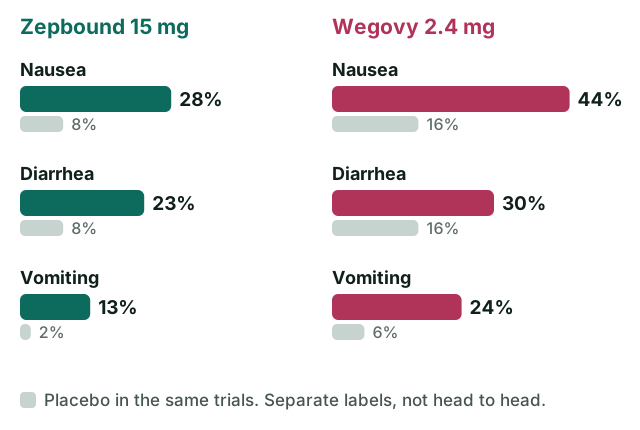
The most common semaglutide side effects are nausea, diarrhea, vomiting, constipation and stomach pain. On Wegovy 2.4 mg, 44% of people had nausea versus 16% on placebo. Most cases are mild to moderate, come around dose increases and fade. Severe stomach pain, a neck lump or trouble breathing needs a call right away.
- What it is
- A GLP-1 receptor agonist from Novo Nordisk, sold as Wegovy injection and tablets (weight management, heart-risk reduction, MASH) and as Ozempic and Rybelsus (type 2 diabetes).
- FDA status
- FDA approved
Ozempic approved Dec 2017; Wegovy injection Jun 2021; Wegovy tablets Dec 22 2025; Wegovy HD 7.2 mg Mar 19 2026. The Wegovy label removed its suicidal behavior and ideation warning in January 2026.
- Evidence level
FDA label
Dosing comes from the FDA-approved prescribing information.
Most people on semaglutide get at least one stomach-related side effect. Most of it is mild to moderate, clusters around dose increases and passes. In the Wegovy label, 73% of people had a gastrointestinal reaction versus 47% on placebo. The figures below come from the FDA labels and pool three placebo-controlled weight trials: 2,116 adults on Wegovy 2.4 mg and 1,261 on placebo, for up to 68 weeks.
| Side effect | Placebo | Wegovy 2.4 mg |
|---|---|---|
| Nausea | 16% | 44% |
| Diarrhea | 16% | 30% |
| Vomiting | 6% | 24% |
| Constipation | 11% | 24% |
| Abdominal pain | 10% | 20% |
| Headache | 10% | 14% |
| Fatigue | 5% | 11% |
| Dyspepsia (indigestion) | 3% | 9% |
| Dizziness | 4% | 8% |
| Abdominal distension (bloating) | 5% | 7% |
| Eructation (burping) | under 1% | 7% |
| Low blood sugar, in people with type 2 diabetes | 2% | 6% |
| Flatulence | 4% | 6% |
| Gastroenteritis (stomach flu) | 4% | 6% |
| Gastroesophageal reflux disease | 3% | 5% |
| Gastritis | 1% | 4% |
| Hair loss | 1% | 3% |
| Dysesthesia (altered skin sensation) | 1% | 2% |
6.8% of people on Wegovy stopped because of a side effect, against 3.2% on placebo. The leading reasons were nausea (1.8% versus 0.2%), vomiting (1.2% versus 0%) and diarrhea (0.7% versus 0.1%). Severe gastrointestinal reactions were reported in 4.1% versus 0.9%. In the larger SELECT heart trial, which ran a median of more than 3 years, 16% on Wegovy and 8% on placebo stopped because of an adverse event.
When do semaglutide side effects start, and how long do they last?
Stomach side effects usually start during the climb to a full dose and fade within days to weeks. A pooled analysis of the STEP 1, 2 and 3 trials found these events were transient and came most often during or shortly after a dose increase. 98.1% were mild to moderate, and 99.5% were not serious. Each step up can bring a fresh round, so feeling fine on one dose does not guarantee the next will go the same way.
An expert consensus on GLP-1 drugs as a class gives a rough timeline. It was funded by Novo Nordisk, so read it as a practical guide and not an independent finding.
| Symptom | When it tends to start | How long it tends to last |
|---|---|---|
| Nausea | Most common in the first 4 to 5 weeks | 8 days or less after it begins |
| Vomiting | During dose increases | 1 to 8 days |
| Diarrhea | First 4 weeks | About 3 days |
| Constipation | First 16 weeks, especially the first 28 days | Longest of the four: a median of 47 days |
One question people ask is whether side effects mean the drug is working. They do not seem to. In the same pooled STEP analysis, people lost similar amounts of weight with or without stomach side effects, so a quiet stomach is no sign that the dose is failing.
Why does semaglutide upset your stomach?
Semaglutide slows stomach emptying and acts on the brain’s appetite centers. Both effects build as blood levels rise, which is why each step up the semaglutide dosage chart can bring symptoms. The labels build the schedule around this: the Wegovy label says to follow it “to reduce the risk of gastrointestinal adverse reactions.”
What helps with semaglutide nausea and constipation?
Eating less at a sitting, eating slowly and stopping when you feel full are the first steps the consensus recommends. The plan itself belongs to your prescriber, and the items below come from either the label or that consensus.
From the label and Medication Guide:
- Slower escalation. The Wegovy label says that if a dose is not tolerated, the prescriber can “consider delaying dosage escalation for 4 weeks.” Maintenance can also be 1.7 mg in place of 2.4 mg.
- Fluids. The Medication Guide says “it is important for you to drink fluids to help reduce your chance of dehydration,” because vomiting and diarrhea can lead to kidney problems.
- Do not double up. An overdose can cause severe nausea, severe vomiting and severe low blood sugar. The missed-dose rules exist for this reason.
- Rotate injection sites. Change the site with each injection, across the abdomen, thigh or upper arm. The injection sites guide shows how.
- For the pill, follow the morning routine. Empty stomach, no more than 4 ounces of plain water, then at least 30 minutes before food, drinks or other oral medicines. If the 25 mg tablet is not tolerated, the label lets the prescriber consider switching to the 1.7 mg injection.
From the expert consensus:
- For any stomach symptom: eat slowly, eat smaller portions more often, eat only when hungry, stop when full, choose bland low-fat food, and avoid lying down after a meal.
- For nausea: crackers, apples, mint or ginger may help, and strong smells are worth avoiding.
- For vomiting: be careful about hydration. If it persists, drink 30 to 60 minutes before or after meals and not during them.
- For diarrhea: drink plenty of fluids. Cut back for now on dairy, coffee, alcohol, soft drinks, sugar alcohols such as sorbitol, and high-fiber foods.
- For constipation: get enough fiber, drink water or other sugar-free liquids, and move more. A stool softener may be an option; ask first.
- For reflux: fatty, fried or processed foods, alcohol and carbonated drinks are common triggers.
If symptoms keep going despite these steps, the consensus says to tell your clinician as soon as possible, and a pause or dose change may be considered.
Wegovy HD (7.2 mg): what changes at the higher dose
The 7.2 mg dose was tested in two 72-week trials with 1,311 people on 7.2 mg, 304 on 2.4 mg and 303 on placebo.
| Side effect | Placebo | Wegovy 2.4 mg | Wegovy HD 7.2 mg |
|---|---|---|---|
| Nausea | 13% | 35% | 39% |
| Vomiting | 6% | 16% | 22% |
| Dysesthesia (altered skin sensation) | 0% | 6% | 22% |
| Constipation | 8% | 19% | 20% |
| Abdominal pain | 7% | 9% | 12% |
| Fatigue | 5% | 9% | 11% |
| Headache | 7% | 8% | 9% |
| Dizziness | 1% | 5% | 6% |
| Hair loss | 1% | 3% | 6% |
| Flatulence | 2% | 2% | 4% |
5% stopped because of side effects on 7.2 mg, 5% on 2.4 mg and 2% on placebo.
Dysesthesia is the new signal: sensitivity, tingling, pain or burning of the skin. The label says it rose with dose and blood levels. Among 288 people who had it on 7.2 mg, 2% stopped the drug, 8% paused it and 23% had the dose reduced. Most of those recovered, and recovery was faster when the dose was changed. 18% had not recovered by the end of the trial. Of 38 people who recovered and went back up to 7.2 mg, 17 had it again. The FDA said in its approval announcement that it is investigating this reaction further.
Wegovy pill side effects
The label’s 64-week pill trial included 204 adults on Wegovy 25 mg tablets. The label says the types and frequency of common side effects were “similar to” the injection table above, and it does not publish a separate table. What it does report:
- 6.9% stopped because of a side effect, versus 5.9% on placebo; gastrointestinal reasons accounted for 3.4% versus 2%.
- Severe gastrointestinal reactions: 2% versus 0%.
- Gallstones: 2.5% versus 1%.
- Dysesthesia: 5% versus none on placebo.
Ozempic side effects in the diabetes trials
The Ozempic label pools placebo-controlled trials in adults with type 2 diabetes, at lower doses than Wegovy.
| Side effect | Placebo | Ozempic 0.5 mg | Ozempic 1 mg |
|---|---|---|---|
| Nausea | 6.1% | 15.8% | 20.3% |
| Vomiting | 2.3% | 5% | 9.2% |
| Diarrhea | 1.9% | 8.5% | 8.8% |
| Abdominal pain | 4.6% | 7.3% | 5.7% |
| Constipation | 1.5% | 5% | 3.1% |
Stopping because of gastrointestinal effects was 3.1% on 0.5 mg and 3.8% on 1 mg, against 0.4% on placebo. In a 40-week trial comparing doses, gastrointestinal reactions were reported by 34% on 2 mg and 30.8% on 1 mg. The molecule is identical to Wegovy; the doses and trial populations were not.
Serious side effects and the boxed warning
Each of these is uncommon, and each is a reason not to wait out a specific symptom. The list follows Section 5 of the Wegovy label, revised June 2026.
- Thyroid C-cell tumors (boxed warning). Semaglutide caused these tumors in mice and rats; whether it does in humans is unknown. Contraindicated with a personal or family history of medullary thyroid carcinoma or Multiple Endocrine Neoplasia syndrome type 2. Report a neck lump, trouble swallowing, shortness of breath or lasting hoarseness.
- Acute pancreatitis. Confirmed in 4 people on Wegovy (0.2 cases per 100 patient-years) versus 1 on placebo in the adult weight trials. The symptom is persistent, severe stomach pain, sometimes into the back. The label says to stop the drug if pancreatitis is suspected. Postmarketing reports include necrotizing pancreatitis, sometimes fatal.
- Acute gallbladder disease. Gallstones in 1.6% on Wegovy injection versus 0.7% on placebo, and cholecystitis (gallbladder inflammation) in 0.6% versus 0.2%. In adolescents, gallstones reached 3.8%. The label says the excess held “even after accounting for the degree of weight loss.”
- Low blood sugar. In the weight trial of adults with type 2 diabetes, glucose below 54 mg/dL occurred in 6.2% on Wegovy versus 2.5% on placebo, and the risk rose with a sulfonylurea. With insulin or a sulfonylurea, the label says prescribers should consider lowering those doses when starting.
- Acute kidney injury from dehydration. Seen in 7 people on Wegovy versus 4 on placebo in the weight trials, some after vomiting or diarrhea, and in postmarketing reports, some needing dialysis.
- Severe gastrointestinal reactions. Wegovy is not recommended in people with severe gastroparesis (a stomach that empties very slowly). Postmarketing reports include ileus, intestinal obstruction, and severe constipation including fecal impaction.
- Serious allergic reactions. Anaphylaxis and angioedema (swelling of the face, lips or throat) have been reported.
- Diabetic retinopathy complications. In a 2-year trial of semaglutide injection, these occurred in 3% versus 1.8% on placebo, and in 8.2% versus 5.2% among people who already had retinopathy. Fast improvement in blood sugar can temporarily worsen diabetic eye disease.
- Heart rate increase. Average resting heart rate rose 1 to 4 beats per minute. 26% of people on Wegovy had a rise of 20 or more beats per minute at some visit, versus 16% on placebo. The label says to stop the drug for a sustained increase at rest.
- Food entering the lungs under anesthesia. Because the stomach empties slowly, the label asks patients to tell every provider about Wegovy before a planned surgery or procedure.
- Never share a FlexTouch pen. Added in June 2026: the multi-dose pen must never pass between people, even with a new needle, because of the risk of blood-borne infection. The Ozempic label carries the same warning for its pens.
The label also reports, outside the warnings section: low blood pressure in 1.3% versus 0.4%, fainting in 0.8% versus 0.2%, appendicitis in 0.5% versus 0.2%, and, in the SELECT trial, more hip and pelvis fractures in women (1% versus 0.2%) and in people 75 and older (2.4% versus 0.6%). Hair loss ran 3.3% versus 1% on 2.4 mg (4% of women and 0.9% of men on the drug) and 5.8% on 7.2 mg (8.4% of women and 0.2% of men), and the label ties it to weight reduction.
One warning has gone the other way. The label’s recent changes mark “Suicidal Behavior and Ideation” as removed in January 2026. A new or worsening mood change still deserves a call, even though it is no longer a labeled warning.
Can semaglutide cause vision loss?
Very rarely, it may. In June 2025 the safety committee of the European Medicines Agency concluded that NAION (non-arteritic anterior ischemic optic neuropathy, a sudden loss of vision caused by reduced blood flow to the optic nerve) is a very rare side effect of semaglutide, affecting up to 1 in 10,000 people. In adults with type 2 diabetes, it cited studies suggesting about a two-fold higher risk, roughly one extra case per 10,000 person-years of treatment.
The US labels are different. We searched the Wegovy label (June 2026), the Ozempic injection label (May 2026) and the Rybelsus and Ozempic tablet label (January 2026), and none of them names NAION. They do warn about diabetic eye complications and tell people with type 2 diabetes to report vision changes. The European advice is to contact a doctor promptly if vision drops suddenly or worsens quickly, and to stop semaglutide if NAION is confirmed.
When to stop semaglutide and call
The Medication Guide uses “stop” or “call right away” for a short list. These are the manufacturer’s instructions, not this site’s.
| What you notice | Could be | What the Medication Guide says |
|---|---|---|
| Severe stomach pain that will not go away, with or without vomiting, sometimes into the back | Pancreatitis | Stop and call right away |
| Swelling of the face, lips, tongue or throat, trouble breathing or swallowing, severe rash or itching, fainting or a very rapid heartbeat | Serious allergic reaction | Stop and get medical help right away |
| Nausea, vomiting or diarrhea that does not go away | Dehydration and kidney problems | Tell your provider right away |
| Stomach problems that are severe or will not go away | Severe stomach reaction | Tell your provider |
| Upper stomach pain, fever, yellow skin or eyes, or clay-colored stools | Gallbladder problems | Call your provider |
| Dizziness, sweating, shakiness, confusion, blurred vision or a fast heartbeat, especially with diabetes on insulin or a sulfonylurea | Low blood sugar | Talk to your provider about how to treat it |
| A racing or pounding heart at rest that lasts several minutes | Increased heart rate | Tell your provider |
| Vision changes with type 2 diabetes | Diabetic eye complications | Tell your provider |
| A neck lump, hoarseness, trouble swallowing or shortness of breath | Thyroid warning | Tell your provider |
If you take too much, the Medication Guide says to call your provider or Poison Help at 1-800-222-1222, or go to the nearest emergency room. You can report a side effect to the FDA at 1-800-FDA-1088.
Do the numbers apply to compounded semaglutide?
They do not, because compounded semaglutide was never in these trials. It comes in multi-dose vials, and the percentages above come from the FDA-approved products. As of May 31, 2026, the FDA had received 990 adverse event reports tied to compounded semaglutide, and says the true number is likely higher because many pharmacies are not required to report. It has documented overdoses of 5 to 20 times the intended dose when units on a syringe were confused with milligrams. The compounded semaglutide guide explains the units math. For the same rates on the other big drug, see semaglutide vs tirzepatide.
Who should not use semaglutide at all
The label’s contraindications are a personal or family history of medullary thyroid carcinoma, Multiple Endocrine Neoplasia syndrome type 2, and a prior serious allergic reaction to semaglutide or any ingredient. It should not be combined with another semaglutide product or another GLP-1 drug. The label advises stopping it at least 2 months before a planned pregnancy, and breastfeeding is not recommended on the tablets. Whether any of this applies to you is a decision to make with your prescriber.
Compare
- GLP-1sFDA approvedDosage chartWegovy starts at 0.25 mg weekly and reaches 2.4 mg at week 17.
- GLP-1sFDA approvedCompounded semaglutideCompounded semaglutide is legal only in narrow cases since the shortage ended in 2025.
- GLP-1sFDA approvedSide effectsNausea hits 25% to 29% of people on Zepbound, mostly during dose increases.
Getting semaglutide legitimately
Affiliate disclosure: some links below pay us a referral fee. It never changes the price you pay or the order we list providers.
Through your own doctor
Any licensed prescriber can write a prescription for an FDA-approved GLP-1 if you meet the label criteria. Insurance coverage for weight management varies; ask the office to run a benefits check first.
Through a telehealth provider
Look for a real consultation with a licensed clinician, a named pharmacy, and a clear statement of whether you are getting the brand product or a compounded version. Avoid any site that ships without a consult.
Provider comparison coming once we have verified pricing and pharmacy sourcing for each program. Until then, the two routes above are the only ones we recommend.
Recent news on this
Peptide news, sorted. Plus the printable dose chart.
Sorted, every Tuesday: the week's peptide and GLP-1 news in five minutes: FDA moves, new studies explained, and price changes. Subscribe and the one-page dose and injection-site chart arrives first.
Questions people ask
How long do semaglutide side effects last?
Does semaglutide cause hair loss?
Can semaglutide cause vision loss?
What is the burning skin feeling on Wegovy HD?
Does Wegovy still carry a suicidal thoughts warning?
Is nausea worse on Wegovy or Ozempic?
Sources
Primary sources first: FDA labels and documents, peer-reviewed trials, registries.
- 1Wegovy (semaglutide) injection and tablets prescribing information and Medication Guide, Novo Nordisk, revised 6/2026novo-pi.com
- 2Wegovy (semaglutide) injection and tablets prescribing information, revised 3/2026, via FDA (Sections 5, 6.1, 17 and Medication Guide)accessdata.fda.gov
- 3Wegovy (semaglutide) injection and tablets prescribing information, Novo Nordisk, revised 6/2026, via DailyMeddailymed.nlm.nih.gov
- 4Ozempic (semaglutide) injection prescribing information, Novo Nordisk, revised 5/2026, via DailyMed (Section 6.1 Table 1)dailymed.nlm.nih.gov
- 5Ozempic (semaglutide) injection prescribing information, revised 5/2026, via FDA (NDA 209637, supplement 38)accessdata.fda.gov
- 6Rybelsus and Ozempic tablets prescribing information, revised 1/2026, via FDA (NDA 213051, supplement 30)accessdata.fda.gov
- 7FDA press release: FDA approves fourth product under National Priority Voucher program, higher dose semaglutide, Mar 19 2026fda.gov
- 8Wharton S et al. Gastrointestinal tolerability of once-weekly semaglutide 2.4 mg in adults with overweight or obesity. Diabetes Obes Metab 2022;24:94-105pubmed.ncbi.nlm.nih.gov
- 9Gorgojo-Martinez JJ et al. Clinical recommendations to manage gastrointestinal adverse events in patients treated with GLP-1 receptor agonists: a multidisciplinary expert consensus. J Clin Med 2022;12:145 (funded by Novo Nordisk)pmc.ncbi.nlm.nih.gov
- 10Wharton S et al. Once-weekly semaglutide 7.2 mg in adults with obesity (STEP UP). Lancet Diabetes Endocrinol 2025pubmed.ncbi.nlm.nih.gov
- 11Lincoff AM et al. Semaglutide and cardiovascular outcomes in obesity without diabetes (SELECT). N Engl J Med 2023pubmed.ncbi.nlm.nih.gov
- 12European Medicines Agency. PRAC concludes eye condition NAION is a very rare side effect of semaglutide medicines Ozempic, Rybelsus and Wegovy, Jun 6 2025ema.europa.eu
- 13FDA. FDA's concerns with unapproved GLP-1 drugs used for weight loss, current as of Oct 1 2026fda.gov
More on Semaglutide
- OverviewSemaglutideSemaglutide is the drug in Wegovy and Ozempic. Adults lost about 15% of body weight in trials. See how it works, the risks and current cash prices.
- Compounded semaglutideCompounded semaglutide is legal only in narrow cases since the shortage ended in 2025. See the FDA rules, what to check on a vial, and units at each dose.Read
- Dosage chartWegovy starts at 0.25 mg weekly and reaches 2.4 mg at week 17. See every label schedule, pen strength, missed-dose rule and unit conversion in one place.Read
PeptideSorted Editorial Team
Editorial review
The PeptideSorted editors check every guide against its cited sources before publication: each number against its FDA label, trial or registry, the FDA status against current FDA and HHS documents, and the wording against our describe-never-prescribe rule. Licensed clinicians who join the review panel are listed by name on the editorial team page.
This page was checked against its cited sources by the PeptideSorted editorial team. Licensed clinicians on our review panel are listed on the editorial team page. Every health page cites primary sources and shows its review date. Read the editorial policy and how medical review works, or report an error via corrections. Educational only; not medical advice.